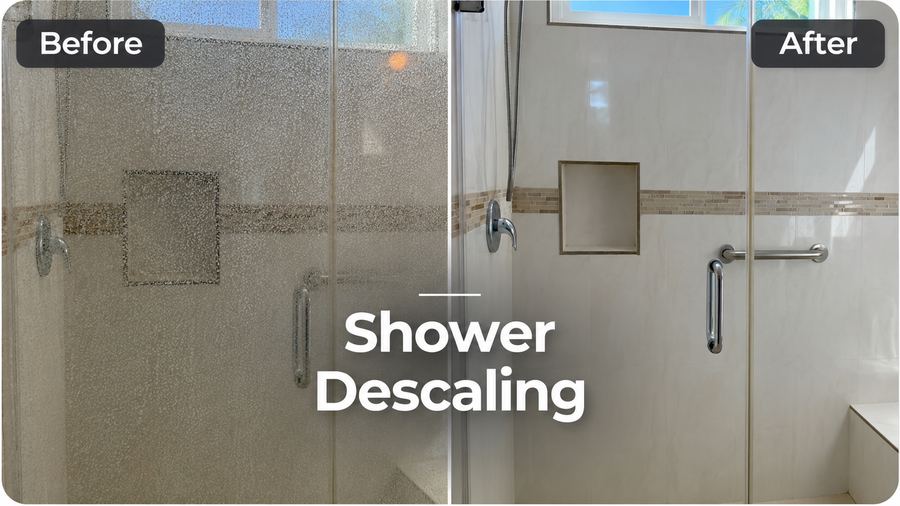
Quick Reference: Executive Summary
| Best For | Cloudy, chalky, or white-spotted shower glass and tile caused by hard water buildup, soap scum, or a combination of both |
| Service Type | Premium add-on service (not included in standard bathroom cleaning) |
| Typical Service Time | ~1 hour for a standard 4' x 4' shower; 1.5–2 hours for larger showers or heavier buildup |
| What This Service Can Restore | Removable mineral (hard water) deposits, soap scum, general haze and dulling on glass and tile |
| What It Cannot Restore | Permanent chemical etching in the glass itself — once minerals have chemically bonded with and pitted the surface, no cleaning process can reverse it |
| Best Long-Term Prevention | A whole-home water softener, paired with squeegeeing the glass after every shower |
If you only read one section of this guide, read the Is This Service Right for Me? section below — it will tell you, in about 60 seconds, whether descaling is likely to help your specific shower.
Is This Service Right for Me?
We'd rather you know what to expect before you book anything — including with us.
Shower descaling is likely a good fit if:
- Your shower glass looks cloudy, foggy, or "frosted," even right after cleaning.
- The glass feels rough or gritty to the touch, almost like fine sandpaper.
- You've tried vinegar or a store-bought glass cleaner and the haze came right back, or never fully left.
- White or chalky spots remain even after wiping the glass down.
- You're seriously considering replacing your shower glass because you assume it's beyond saving.
- It's been more than a year (often much longer) since the shower glass was last professionally treated.
This service may NOT be necessary if:
- Your glass is simply dusty or has light everyday soap residue — a standard bathroom cleaning may be all you need.
- The haze wipes away completely with a normal glass cleaner and a microfiber towel — that's usually just surface residue, not bonded mineral deposits.
- Your glass has visible scratches, chips, or cracks rather than cloudiness — that's physical damage, not mineral buildup, and no cleaning process (ours or anyone else's) can fix it.
- You already have a whole-home water softener and clean the glass regularly — you may just need routine maintenance rather than a full restoration visit.
If you're not sure which category your shower falls into, a photo is usually enough for us to give you an honest read before you book anything.
Why Your Shower Glass Looks Cloudy (And Why It's Probably Not What You Think)
If you've stood in your shower and squinted through glass that looks permanently fogged, you've probably already had the thought: this glass needs to be replaced. Before you make that call, it's worth understanding what's actually happening on the surface.
What most homeowners are looking at isn't dirt. It's mineral deposits — specifically calcium and magnesium left behind as hard water evaporates off the glass. Over time, those minerals harden into a chalky film. If it sits long enough, it can begin to chemically etch the surface of the glass itself. That's the real distinction that matters: removable mineral buildup versus permanent etching. One can be restored. The other can't. And you often can't tell the difference just by looking — it takes a technician who knows what to test for.
There's also a second culprit that's frequently confused with hard water: soap scum. The two feel different under your hand. Hard water deposits are rough and chalky. Soap scum is slick, almost greasy. Most neglected showers have a combination of both, which means the cleaning approach has to address each one differently — treating only one leaves the shower still looking dirty.
Soap Scum vs. Hard Water: How to Tell the Difference
| Soap Scum | Hard Water Deposits | |
|---|---|---|
| Feel | Slick, greasy | Rough, chalky, gritty |
| Cause | Soap and body oil residue | Calcium and magnesium left behind as water evaporates |
| Appearance | Filmy, sometimes yellowish | White, cloudy, "frosted" look |
| Typical Fix | Degreasing cleaner and scrubbing | CLR-based dwell time, razor work, mechanical scrubbing |
| Can Coexist? | Yes — most neglected showers have both | Yes — most neglected showers have both |
Can We Restore It?
| Condition | Usually Restorable? |
|---|---|
| Soap scum | Yes |
| Hard water / mineral deposits | Usually |
| Light surface haze | Yes |
| Permanent chemical etching | No |
| Scratches or chips in the glass | No — this is physical damage, not buildup |
Why North County San Diego Has Hard Water
This isn't unique to your house — it's a regional water quality issue. Southern California's water supply, including throughout San Diego County, carries a naturally higher concentration of dissolved calcium and magnesium than water in many other parts of the country. Every time that water evaporates off a shower wall, it leaves behind a small amount of mineral residue. On its own, one shower's worth of residue is nothing. Repeated daily for months or years without a water softener or regular squeegeeing, it builds into the chalky film — and eventually the etching — that we're describing throughout this guide.
That's why hard water buildup shows up in homes throughout San Marcos, Vista, Escondido, Carlsbad, and Oceanside almost regardless of how well-maintained the rest of the home is. It's a water chemistry issue, not a cleanliness issue.
Coastal homes add a second factor on top of that. In Carlsbad and Oceanside, salt carried in the ocean air settles on surfaces throughout the home, including bathroom fixtures and glass. Combined with the region's hard water, that salt exposure tends to accelerate buildup and, over time, etching — which is part of why we consistently see more severe shower glass condition in coastal homes than in homes further inland like Vista, San Marcos, and Escondido.
None of this means coastal living is a mistake, or that hard water is a crisis — it's simply the water and air we all share throughout the region, and understanding it is the first step to managing it.
DIY vs. Professional Shower Descaling
We're not going to tell you that DIY never works — it does, in a lot of cases. What matters is knowing which situation you're in.
When DIY works reasonably well:
- Light, recent buildup that hasn't had time to bond with the glass.
- Regular maintenance cleaning between professional visits — a squeegee and a basic glass cleaner go a long way.
- Homes with a water softener already installed, where mineral buildup is minimal to begin with.
When DIY struggles or backfires:
- Vinegar can help with very light buildup, but it's a mild acid — it often isn't strong enough to break down deposits that have had months or years to harden, and repeated exposure without protecting the surrounding fixtures can be a mixed bag.
- Magic Erasers and abrasive sponges feel satisfying because they seem to "cut through" the haze quickly — but that sensation is often the sponge microscopically abrading the glass's protective coating, not just removing buildup. Once that coating is compromised, the glass actually holds onto minerals and soap scum more easily going forward.
- Steel wool or other harsh metal scrubbers can scratch glass outright.
- Bleach can also wear away the glass's protective factory coating over time.
The reason homeowners accidentally damage their own shower glass almost never comes down to carelessness — it comes down to not knowing that scrubbing harder or reaching for a stronger product can create microscopic scratches that trap even more minerals and soap scum in the future, making the next round of buildup worse and harder to remove.
When professional descaling is the better option:
- The glass feels rough or gritty even after cleaning.
- Buildup has clearly been there for a long time (a year or more).
- You've already tried DIY methods without meaningful improvement.
- You're deciding between restoration and full glass replacement and want an honest, in-person assessment first.
The Biggest Mistake Homeowners Make (And Why It Makes the Problem Worse)
The most common mistake isn't failing to clean the shower — it's cleaning it the wrong way. Aggressive scrubbing with abrasive sponges, or reaching for bleach, can wear away the glass's protective factory coating. Once that coating is compromised, it creates microscopic scratches — and those scratches trap even more minerals and soap scum going forward, making the problem worse every time it happens again.
The single best long-term fix isn't a product at all. It's a water softener. Installing one doesn't just help your shower glass — it protects your faucets, fixtures, appliances, and plumbing throughout the entire home, because it addresses the mineral content at the source instead of fighting the symptoms one surface at a time.
How Cali Clean Team Descales a Shower
Shower descaling is a premium add-on at Cali Clean Team — it isn't part of a standard bathroom cleaning, because doing it properly takes real time and a different set of tools. Here's the process our technicians follow, top to bottom, left to right, on every job. We inspect before we scrub, because every shower is different, and the right first move depends on what we actually find — not on a generic checklist.
- Assess the surface. We identify whether we're dealing with hard water mineral deposits, soap scum, or — as is common — both, since the treatment differs for each.
- First application. We spray the glass with CLR to begin breaking down the mineral deposits and let it dwell for approximately 3–4 minutes.
- Razor scrape. Using a razor blade, we carefully scrape the glass to clear a path through the buildup — this step requires real technique, since the wrong angle or pressure can scratch the glass.
- Second application. A second coat of CLR goes onto the glass to continue breaking down what's left.
- Hand scrubbing. We scrub using a stainless steel or copper scrubber, working by feel — literally running a hand across the glass — until the gritty texture of the mineral deposits is gone and the surface feels smooth.
- Escalation when needed. For stubborn buildup that won't fully release, we move to a rotary scrubbing tool combined with Dawn Powerwash, which breaks down heavier deposits more effectively.
- Tile. Once the glass is finished, we repeat the same systematic process on the tile.
Every shower is evaluated individually. We don't apply the same method to every job — the severity of the buildup determines how aggressive the process needs to be from the start. We'd rather tell someone honestly that their glass can't be fully restored than promise a result we can't deliver.
[Before & After Gallery Placeholder — insert real customer photos here once available, showing glass before and after descaling]
What We See Across North County San Diego
Years of descaling showers throughout North County have shown a consistent pattern: coastal homes and inland homes are not the same.
Carlsbad and Oceanside (coastal): Salt air combines with hard-water minerals, soap scum, and general surface wear, making restoration more difficult. We consistently find more severe etching and buildup in coastal homes than inland ones. Because these jobs typically require more labor and more aggressive techniques, coastal shower descaling may cost more — not because of the zip code, but because of the actual condition and time required.
Vista, San Marcos, and Escondido (inland): Without the constant salt-air exposure, hard water is still a factor, but restoration is generally more straightforward.
A Real Case Study: Two Showers, Two Outcomes
We've handled this exact situation for two different clients — one in Carlsbad, one in San Marcos. In both cases, the shower glass looked like a permanent cloud, and both homeowners were convinced they needed an entirely new shower enclosure.
For the more severe Carlsbad shower — where salt air had compounded the mineral buildup — we skipped the lighter approach entirely and went straight to the rotary scrubber and stronger methods, because a lighter touch would have wasted time without results. The razor blade played a critical role in safely removing mineral deposits without scratching the glass, which takes real experience to do correctly.
The lesson from that job: using the wrong tool or technique can permanently scratch shower glass, turning something that was restorable into something that genuinely needs replacement. Every shower gets evaluated individually, and the process adjusts to the severity of what we find — not a one-size-fits-all method.
Replacement vs. Restoration
If you're standing in your bathroom convinced the glass "just needs to be replaced," it's worth pausing on that decision. In our experience, the majority of cloudy shower glass we're called out to look at is restorable, at least to a meaningful degree — full replacement is usually only the right call when the glass has permanent etching, physical damage, or has already been scratched by an overly aggressive cleaning attempt.
We're not going to quote exact prices in this guide, since every shower's condition is different — but as a general principle, professional descaling is almost always worth attempting before committing to the cost, mess, and downtime of replacing an entire shower enclosure. If descaling doesn't get you the result you're hoping for, you haven't lost the option to replace the glass afterward — you've just ruled it out first, with real information instead of a guess.
Maintenance Tips: Keeping Restored Glass Looking Better, Longer
Restoration only holds up as well as the maintenance behind it. A few habits make a real difference:
- Squeegee the glass after every shower. This is genuinely the single highest-impact habit — it removes standing water before it has the chance to evaporate and leave mineral residue behind.
- Dry the glass with a towel occasionally, especially in the corners and along the bottom track, where water tends to sit longest.
- Install a water softener if you don't already have one. It's the one investment that addresses the actual cause of hard water buildup rather than just the symptom.
- Clean on a regular schedule rather than waiting until buildup is visible — light, frequent cleaning is dramatically easier than restoring months or years of accumulation.
- Avoid abrasive products — no steel wool, no harsh scouring powders, no bleach directly on the glass. These are exactly what create the microscopic scratches that make future buildup worse.
- Use a basic glass cleaner or a vinegar-water mix for routine upkeep between deeper cleanings — this is fine for light residue, even though it's not strong enough for established mineral deposits.
Setting Realistic Expectations
Here's what actually affects the outcome and the price:
- Location — coastal vs. inland exposure
- Time since the shower was last descaled
- Whether the home has a water softener
These factors determine how much labor is involved, which is why pricing reflects the condition of the shower rather than a flat rate.
Typical time: A standard shower (roughly 4' x 4') takes about an hour. Larger showers or heavier buildup can take 1.5 to 2 hours.
What we can promise: We can't guarantee every shower comes out looking brand new. What we can promise is that it will be significantly better than when we started — often dramatically so. Some mineral etching is permanent and cannot be reversed by any cleaning method. Even so, descaling is almost always far less expensive than replacing the glass entirely, which is why it's worth attempting first.
Local Relevance
Cali Clean Team descales showers throughout North County San Diego, and the condition of your shower often depends on where you live. Homes in Carlsbad and Oceanside deal with the added challenge of salt-laden coastal air, which accelerates mineral buildup and etching on shower glass and fixtures. Homes in Vista, San Marcos, and Escondido are further inland and generally see less severe buildup, though hard water remains a factor throughout the region because of Southern California's water supply. Wherever you're located, our technicians assess your shower's actual condition on-site rather than assuming a fixed process for every home.
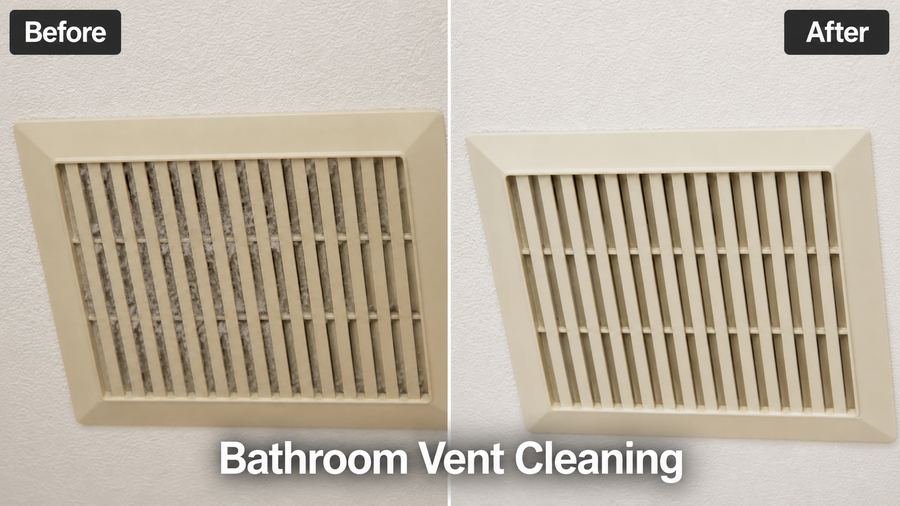
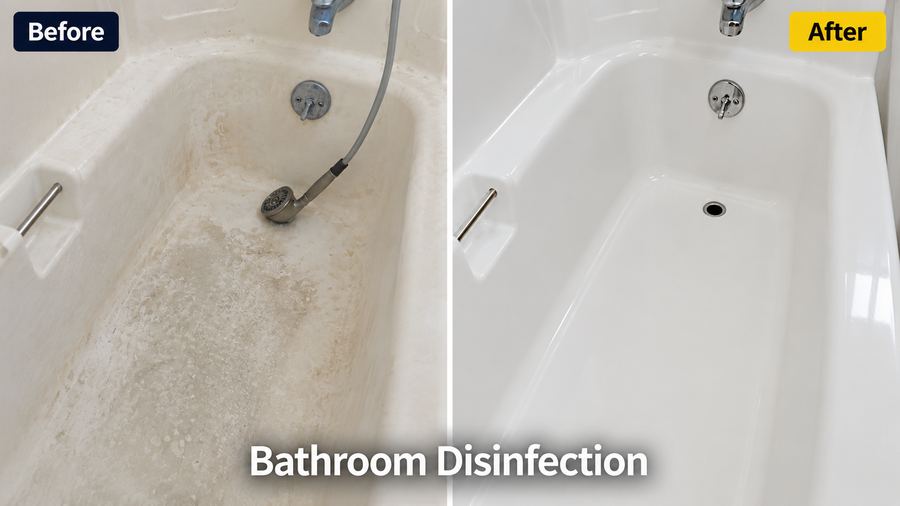
If you're comparing this to other services, shower descaling pairs naturally with a deep cleaning visit, and the same top-to-bottom, left-to-right philosophy carries over into our bathroom disinfection process, our bathroom vent cleaning, and even material-care services like stainless steel restoration and window track cleaning — all built around the same principle of inspecting before we scrub. If you're moving out, our move-out cleaning can include descaling as an add-on, and if you're a recurring client, ask about adding it to your recurring cleaning schedule. Commercial property managers dealing with hard water in shared bathrooms can also find this useful alongside our commercial cleaning services.
The Bottom Line
If there's one thing we want you to take away from this guide, it's this: cloudy shower glass is usually a solvable problem, not a reason to start shopping for a replacement enclosure. Understanding whether you're dealing with soap scum, removable mineral buildup, or true permanent etching is the difference between spending money wisely and spending it on the wrong fix. We'd genuinely rather walk you through that assessment honestly — even if the answer is "this one needs replacing" — than oversell a service that won't deliver the result you're hoping for.
Ready to find out what's really under the buildup? Get a shower descaling quote or call (760) 582-2520 — we're happy to take a look at photos first if you're not sure which category your shower falls into.