Cross-Contamination Prevention at a Glance
| Best For | Homeowners wanting a documented, consistent cleaning process rather than a vague promise — especially households with pets, children, or health-sensitive members |
| Service Type | Built into every cleaning we perform, not a separate add-on |
| Main Objective | Reduce the risk of transferring soil, residue, and contaminants from one surface, room, or task to another |
| Fresh-Cloth Standard | A fresh set of cloths begins in each room; used cloths are removed from service rather than stretched across the whole house |
| Tool-Separation Standard | Toilet tools, floor tools, and food-contact tools remain in their own zones — not just their own room |
| Mop-Pad Standard | Dedicated mop pads for kitchens, bathrooms, and living areas — never shared across zones |
| Glove Standard | Gloves are changed after toilet work, heavily soiled tasks, or when torn or compromised |
| What the Process Can Reduce | The risk of transferring dirt, residue, and contaminants between rooms and surfaces |
| What It Cannot Guarantee | Sterilization, elimination of every microorganism, or prevention of illness or allergic reactions |
| When Service May Be Declined | Biohazard conditions, sewage, sharps, pest waste, or extensive mold-like growth |
| Cities Served | San Marcos, Carlsbad, Oceanside, Vista, Escondido, and surrounding North County San Diego communities |
What Cross-Contamination Means
Cross-contamination is the unintended transfer of soil, residue, allergens, chemicals, microorganisms, or other contaminants from one surface, room, tool, cloth, glove, or cleaning solution to another.
Professional procedures are designed to reduce the risk of that transfer — not eliminate it entirely. We're not going to tell you bacteria "never travels" once a system is in place, because that's not an honest claim for any residential cleaning service to make. What a well-run system can do is meaningfully lower the chances of moving contamination from a bathroom into a kitchen, or from one heavily soiled area into one that's already been cleaned.
Cleaning vs. Sanitizing vs. Disinfecting
| Process | Main Purpose | What It Requires | Relationship to Cross-Contamination |
|---|---|---|---|
| Cleaning | Removes soil and residue | Compatible product, friction, and physical removal | Reduces the material available to transfer elsewhere |
| Sanitizing | Reduces microorganisms according to a labeled method | Correct product, concentration, and contact time | Used only where appropriate for that surface |
| Disinfecting | Kills specified organisms according to an EPA-registered label | A compatible surface, pre-cleaning when required, and full wet contact time | A separate step from simply wiping with a fresh cloth |
| Tool separation | Prevents one used tool from entering another zone | Training, consistent color coding, and replacement | Reduces transfer between areas, independent of the product used |
A surface isn't disinfected simply because it was wiped with a fresh cloth — that's cleaning, and it's a meaningfully different claim than disinfecting.
How Contamination Actually Moves During Cleaning
Contamination transfers through a handful of predictable pathways:
- Cloths — a single cloth used across multiple surfaces or rooms.
- Mop pads — carrying residue from one floor zone into another.
- Gloves — worn through multiple contaminated tasks without changing.
- Brushes — used in one area, then another, without cleaning or replacement.
- Vacuum attachments — moved between surfaces without consideration.
- Cleaning water — reused past the point of being effective.
- Bottles and caddies — carrying residue on their exteriors from one room to the next.
- Hands — the most basic and easily overlooked transfer point.
- Phones and personal items — touched with contaminated gloves or hands.
- Improper cleaning sequence — cleaning a dirtier area before a cleaner one, then moving forward without changing tools.
We're not making disease-transmission claims here — this is simply how physical transfer happens during a cleaning process, and it's what a documented system is designed to interrupt.
The Cali Clean Team System
This isn't a slogan — it's a defined operating system with ten components:
- Fresh cloths — a new set begins in each room.
- Task-zone separation — tools are separated by task, not just by room.
- Dedicated mop pads — kitchens, bathrooms, and living areas each get their own.
- Color-coded brushes — a visual control that helps prevent accidental cross-use.
- Gloves and hand hygiene — changed at the right points in the process.
- Clean-to-dirty workflow — lower-risk areas addressed before higher-risk ones.
- Controlled cleaning solutions — replaced rather than stretched across the whole home.
- Tool reprocessing — reusable equipment checked and cleaned before reuse.
- Laundry separation — used textiles kept apart from clean ones.
- High-touch-surface attention — light switches, handles, and similar surfaces addressed deliberately.
Each of these reduces risk. None of them, alone or together, amounts to a guarantee.
A Fresh Room Is Not Enough: Tools Must Also Be Separated by Task
A fresh cloth set beginning in each room is a good start, but it's not the whole system. Toilet cloths and tools remain dedicated to toilet work specifically — a bathroom sink cloth doesn't become a toilet cloth and then return to the sink. Kitchen floor tools don't touch counters. Refrigerator-interior tools stay separate from general floor and bathroom tools. Heavily contaminated cloths are retired immediately rather than pushed to do more work than they should. One cloth isn't stretched across every surface in a room just because it happens to still be in the same physical space.
How the Color-Coding System Works
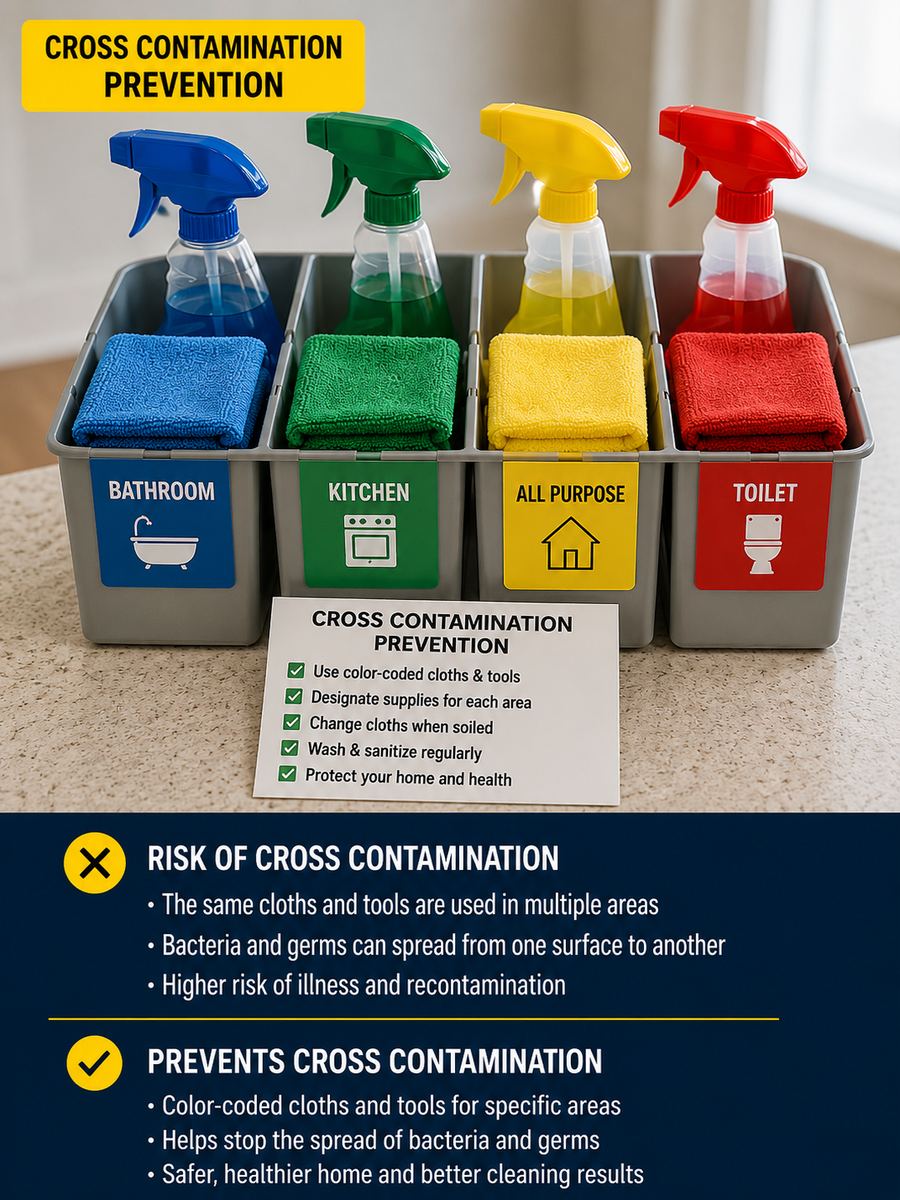
Colors are assigned to specific zones or tasks — for example, distinguishing tools meant for food-contact areas from tools meant for toilets. Staff are trained on what each color means, and the system is applied consistently across crews so results don't depend on which technician shows up.
A few important clarifications:
- Color coding is a visual control, not a cleaning or disinfecting method. The color itself doesn't clean or sanitize anything — it just reduces the chance of a tool ending up in the wrong place.
- Every reusable color-coded tool still needs proper reprocessing between uses — the color doesn't substitute for actually cleaning the tool.
- Worn, damaged, or heavily contaminated tools are removed from service rather than continuing to be used because they're "the right color."
- If a customer provides their own dedicated-supply system (as described in the case study below), we follow it once we've clearly agreed on how it works.
Glove Use and Hand Hygiene
Gloves aren't simply worn once at the start of a cleaning and left on for the entire visit. Gloves are selected according to the task and the product being used, and they're changed after toilet work and other heavily contaminated tasks, or whenever they're torn, visibly soiled, or chemically compromised.
Contaminated gloves don't touch clean cloths, phones, door handles, or personal items. Hand hygiene is performed after glove removal when appropriate. Product labels and safety data sheets guide what protective equipment is used for a given task — we're not making clinical PPE claims here, just describing the practical standard we follow.
Sequence Is Part of Cross-Contamination Control
The order tasks happen in matters as much as the tools used. Higher and cleaner surfaces are generally handled before floors and toilets. Lower-risk areas are cleaned before higher-risk ones. Toilet and floor work happen after cleaner zones are already finished, not before. Dirty tools don't pass back over areas that have already been completed. Personal items are protected before any product is used nearby, and clean supplies are only handled with clean hands or gloves. Where appropriate, final high-touch treatment happens only after the surrounding cleaning is complete.
This connects to our broader philosophy: top to bottom, left to right — adjusted whenever necessary to maintain clean-to-dirty separation, since a rigid pattern that ignores contamination risk isn't actually the goal.
What Happens to Used Towels and Mop Pads?
Used textiles are removed from active service rather than continuing to be used past the point where they're still doing their job. Clean and used items are stored separately, and used items go into a designated container rather than sitting loose with clean supplies. Heavily contaminated materials may require separate handling from routine laundry. Reusable cloths and pads are laundered before reuse, and dried completely before returning to clean storage. Clean supplies are protected during transport between jobs, and single-use items are discarded when applicable.
We're not going to publish specific wash temperatures, chemicals, or disinfectant-cycle claims here unless those are confirmed as accurate to our actual operational process — "professionally laundered" is used only to the extent it reflects what actually happens.
Reusable-Tool Reprocessing
Reusable equipment — brushes, vacuum attachments, mop hardware, buckets, bottles, caddies, and scrapers — is checked, cleaned, and allowed to dry as appropriate before it's used again. Visible cleanliness alone doesn't prove a tool has been properly reprocessed, which is part of why this is a defined step rather than an assumption. We're not claiming a sterilization or disinfection protocol for these tools — just a consistent process of checking, cleaning, and drying before reuse.
Cleaning-Solution and Water Management
Dirty solution is replaced as needed rather than used well past its effectiveness. Heavily soiled cloths aren't repeatedly dipped back into clean solution. Bathroom mop water doesn't continue on into the kitchen. Depending on the task, separate solutions or more controlled product application may be used. Product containers are kept clean enough that they don't become their own source of transferred residue. Chemicals are never mixed, and label dilution and application instructions are followed as written — we're not providing chemical recipes here, just the principles that guide how solutions are managed.
Special Rules for Kitchens and Food-Contact Areas
Bathroom and toilet tools never enter food-preparation zones. Floor cloths and mop pads don't touch counters. Refrigerator-interior tools stay separate from general-purpose tools. Raw-meat residue receives separate handling from other kitchen cleaning. Food, utensils, and small appliances are protected during the process. Product-label rinsing instructions are followed where required, and not every food-contact surface gets treated with the same product — what's appropriate depends on the surface and the product label. This connects directly to the standards described in our refrigerator cleaning guide, where dedicated tools and careful handling of raw-food residue are described in more detail.
Bathrooms and Toilet Zones
Toilet tools remain dedicated to the toilet — full stop. Toilet work happens after cleaner fixtures like the sink and shower are already addressed, not before. Gloves and cloths are changed following toilet work. Floor tools stay at floor level and don't move to counters or fixtures. Toilet tools never enter kitchen or sink zones, in any room. This is described in more operational detail in our bathroom cleaning, sanitizing & disinfection guide, which covers the full clean-to-dirty bathroom workflow.
High-Touch Surfaces
Light switches, door handles, cabinet pulls, faucet handles, appliance handles, toilet flush handles, and remote controls (when included and compatible) are all common transfer points that are easy to overlook during a routine clean. High-touch surfaces are common transfer points and are easy to overlook — but we're not going to claim they're always the single largest source of contamination in every home, since that depends heavily on the household.
Whether a given high-touch surface is cleaned, sanitized, or disinfected depends on the surface material, household conditions, the scope of that particular service, the product label, and whether anyone in the home is currently ill.
Households With Additional Health Concerns
If your household has additional health considerations, we'd genuinely like to know before service — not after. Customers should communicate any requested precautions in advance, and we can discuss dedicated supplies or customer-provided materials where that makes sense. Products and procedures may be adjusted when practical and clearly agreed upon between us.
To be direct about the limits here: cleaning is not medical advice, and residential cleaning is not clinical infection control. We do not guarantee prevention of infection, illness, asthma symptoms, or allergic reactions. Customers should continue to follow the recommendations of their own healthcare professionals for any medical concern — we're a cleaning company, not a substitute for that guidance.
A Real Case Study: Respecting a Customer's Dedicated-Supply System
One of the most meaningful cleaning projects we've taken on involved a customer with an autoimmune condition. Because the homeowner's health made infection control especially important to them, they provided a dedicated set of cleaning supplies — including their own microfiber towels — to be used only inside their home.
The homeowner had organized those towels by color so each area of the home had its own designated cloths, which reinforced the same cross-contamination principles we already follow. By respecting the homeowner's system and combining it with our own procedures, we were able to work in a way that gave both the homeowner and their caregivers confidence that reasonable precautions were being taken.
We want to be precise about what this story does and doesn't demonstrate. It doesn't mean the system prevented illness, and it isn't a claim of medical approval. It shows that a documented process, combined with clear communication and a customer's own preferences, can be respected consistently — that's the whole lesson, not a broader claim about health outcomes.
[Note: this case study remains anonymized. Confirm internally before publishing that no identifying details have been included and that the customer would be comfortable with this description being public.]
When Standard Cross-Contamination Procedures Are Not Enough
Some situations go beyond what a standard residential cross-contamination system is built to handle:
- Significant blood
- Vomit
- Fecal contamination outside routine scope
- Sewage
- Sharps
- Rodent droppings
- Pest waste
- Requests for active infectious-disease cleanup
- Medical isolation protocols
- Extensive mold-like growth
- Unknown biological contamination
Standard residential cleaning is not biohazard remediation, medical-grade terminal cleaning, sewage remediation, sharps handling, mold remediation, or pest-waste remediation. If we encounter any of these conditions, we may stop, decline that portion of the work, or refer you to the appropriate specialist.
Is This System Right for Your Home?
It may be especially valuable if:
- You want a documented process rather than a vague promise.
- Multiple bathrooms are being cleaned in the same visit.
- Your home includes pets or children.
- You're establishing a recurring cleaning schedule.
- Food-preparation and bathroom areas need strict separation.
- You'd like to use dedicated, customer-provided supplies.
- Your household has practical sensitivities you want to communicate in advance.
Standard residential cleaning may not be appropriate if:
- Biohazard remediation is required.
- Sewage is present.
- Sharps are present.
- Medical terminal cleaning is being requested.
- Pest waste is present.
- Extensive mold-like growth exists.
- Unknown biological contamination is present.
We're not going to promise medical protection in either scenario — the value here is a consistent, documented system, not a clinical guarantee.
DIY vs. Professional Cross-Contamination Control
DIY may be appropriate when homeowners:
- Use separate cloths for different rooms.
- Keep toilet tools isolated from everything else.
- Change gloves or wash hands between tasks.
- Replace dirty water regularly.
- Follow product labels carefully.
- Protect food-contact areas during cleaning.
Professional systems may add value through:
- Crew-wide consistency, regardless of who shows up.
- Clearly defined tool zones.
- Standardized training across every technician.
- Fresh supplies for every visit.
- Documented sequencing rather than ad hoc habits.
- Consistent application across a recurring cleaning schedule.
There's no shame in a well-run DIY approach — many of the same principles apply whether it's you or a professional crew doing the work.
North County San Diego Relevance
Cali Clean Team applies the same cross-contamination system in every home throughout North County San Diego — San Marcos, Carlsbad, Oceanside, Vista, and Escondido alike. The operating standard doesn't change based on neighborhood; fresh cloths, task-zone separation, and clean-to-dirty sequencing apply the same way in every home we service, regardless of location.
Preparing for Service
- [ ] Communicate any health or product concerns in advance
- [ ] Identify any specialty surfaces that need particular care
- [ ] Put away medications and personal items
- [ ] Secure pets and children during the visit
- [ ] Disclose any sewage, sharps, pest, or bodily-fluid concerns before we arrive
- [ ] Confirm any customer-provided supplies before the visit, so we know exactly how to use them
- [ ] Let us know about allergies or fragrance preferences — we'll do what's practical, without promising a medical guarantee
- [ ] Please avoid applying or mixing your own chemicals shortly before the appointment
Setting Realistic Expectations
The system can:
- Reduce tool-to-surface transfer risk.
- Improve consistency across visits and technicians.
- Keep bathroom tools out of kitchens.
- Limit reuse of contaminated textiles.
- Create clear, repeatable team standards.
- Support a more hygienic residential cleaning process overall.
It cannot:
- Sterilize a home.
- Eliminate every microorganism.
- Prevent illness.
- Treat allergies or any medical condition.
- Replace biohazard remediation.
- Guarantee that no transfer ever occurs, under any circumstance.
- Provide hospital-grade infection control.
Maintenance Between Visits
- Keep separate cloths for kitchens and bathrooms.
- Replace dirty water rather than stretching it across every room.
- Wash your hands after cleaning the toilet.
- Follow product contact times listed on the label.
- Keep toilet brushes isolated from everything else.
- Avoid reusing floor cloths on counters.
- Launder cloths before reusing them.
- Allow tools to dry fully before storing them.
- Protect food-contact areas during your own routine cleaning.
- Never mix cleaning chemicals.
Local Relevance
Cali Clean Team applies the same cross-contamination prevention system in every home throughout North County San Diego — San Marcos, Carlsbad, Oceanside, Vista, and Escondido alike. The standard is consistent regardless of neighborhood or customer type, because the goal — reducing the risk of transfer between rooms and tasks — doesn't change from house to house.
This system connects directly to our bathroom cleaning, sanitizing & disinfection guide and our refrigerator cleaning guide, both of which describe task-specific tool separation in more detail. It's built into every standard house cleaning and deep cleaning we perform, and carries through recurring cleaning, move-out cleaning, and post-construction cleaning alike. The same dry-debris-first, tool-separation philosophy shows up in our dust bunny removal guide and our bathroom vent cleaning guide. Commercial clients can find related standards in our commercial cleaning services, or find your area on our San Marcos, Carlsbad, Oceanside, Vista, or Escondido service pages.