Dust Bunny Removal at a Glance
| Best For | Recurring dust buildup behind doors, along baseboards, in corners, and in accessible under-furniture areas |
| Service Type | Included as part of standard cleaning — not a separate premium add-on |
| What Standard Cleaning Includes | Room-perimeter vacuuming, crevice attachment work along baseboards and corners, behind open doors, and accessible under-furniture areas without moving anything |
| What Requires Advance Arrangement | Furniture that needs to be moved or lifted, items stored under beds, heavy dressers, or delicate/electronics-heavy setups |
| What's Outside Standard Scope | Moving refrigerators, ranges, or gas appliances; disassembling beds; lifting mattresses; anything requiring more than safe, routine furniture access |
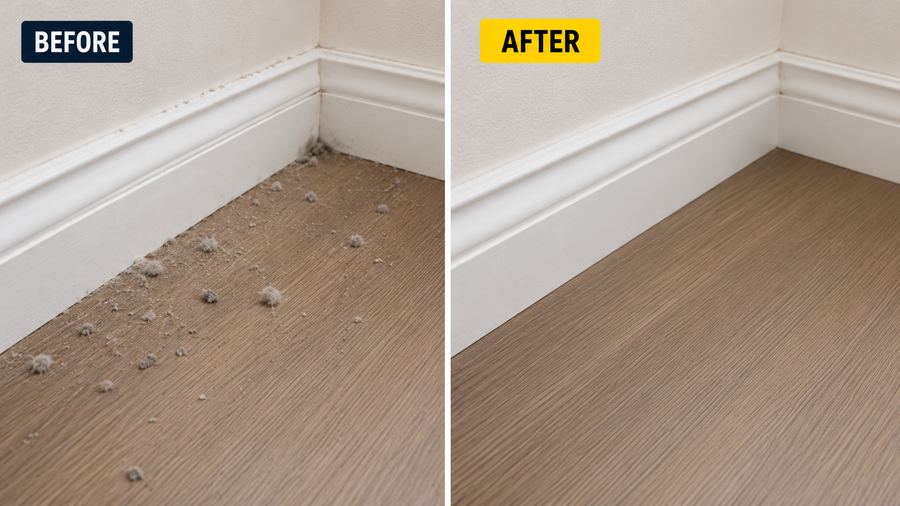
| What May Improve | Loose dust, hair, pet fur, lint, crumbs, and visible debris along edges, corners, and accessible under-furniture spaces |
| What May Remain | Dust in genuinely inaccessible spaces, buildup under extremely heavy furniture, or embedded soil in carpet requiring specialty equipment |
| Main Safety Rule | We don't move heavy furniture, appliances, or anything that risks damage or injury without advance arrangement |
| When Service May Be Declined | Rodent droppings, suspected lead or hazardous dust, broken glass, active pest contamination, or mold-like debris |
| Cities Served | San Marcos, Carlsbad, Oceanside, Vista, Escondido, and surrounding North County San Diego communities |
What Dust Bunnies Are Actually Made Of
There's no single fixed recipe for a dust bunny — the exact composition varies by household, but common contributors include:
- Hair
- Pet fur
- Pet dander
- Textile fibers
- Lint
- Soil particles
- Crumbs
- Insect fragments
- Fine household dust
- Other lightweight debris
Composition varies based on the household — pets, flooring type, ventilation, how many people live there, and the general activity level in the home. There's no need to overstate any single ingredient here; it's genuinely a mixture that depends on your specific home.
Why Dust Bunnies Form in the Same Places
Dust bunnies tend to show up in predictable spots for a combination of reasons:
- Low air movement in corners and behind furniture, where dust isn't disturbed as often.
- Air currents that push lightweight debris into protected areas.
- Static charge, which can cause fine particles to cling to certain surfaces or each other.
- Low foot traffic areas, where nothing physically disturbs accumulating debris.
- Furniture blocking routine access, creating pockets that don't get touched during everyday tidying.
- Gaps around doors and baseboards, which naturally collect debris over time.
- Pet activity, especially in homes where pets have favorite resting spots.
- Long intervals between detailed cleaning, which is really the biggest factor of all — even a low-traffic corner won't accumulate much if it's addressed regularly.
Airflow alone doesn't explain every accumulation — it's usually a combination of these factors specific to your home's layout and habits.
Sweeping vs. Vacuuming vs. Microfiber Dusting
There's no single "best" tool for every situation — the right method depends on the floor, the debris, and what's practical in the moment.
| Method | Best Use | Main Limitation | Suitable Surfaces |
|---|---|---|---|
| Broom | Removing larger, visible debris quickly | Can push fine dust toward edges or resuspend particles into the air rather than capturing them | Hard floors |
| Vacuum (standard head) | General floor cleaning, open areas | Less effective in tight corners or crevices without the right attachment | Carpet, hard floors |
| Vacuum (crevice attachment) | Baseboards, corners, edges, tight gaps | Slower for large open areas | Carpet, hard floors, tight spaces |
| Microfiber duster | Surfaces where vacuuming is impractical, light dust capture | Less effective on heavier or compacted debris | Furniture, some floor edges |
| Flat mop | Final floor-cleaning step after vacuuming | Not a substitute for removing dry debris first | Hard floors, tile, vinyl |
Sweeping isn't something to feel bad about — it removes larger visible debris effectively. It's just generally less effective than vacuuming for capturing fine dust, hair, and debris packed into crevices, and it can occasionally push dust around rather than fully removing it. Vacuuming, especially with the right attachment, tends to be more thorough for that specific job.
Why the Vacuum and Filter Matter
A vacuum only captures debris as well as its bag, filter, seals, and overall maintenance allow. A few things worth understanding:
- Poorly maintained equipment — a clogged filter, a torn bag, worn seals — can actually recirculate fine dust back into the room instead of capturing it.
- HEPA-filtered equipment may reduce fine-particle exhaust when it's properly maintained, but HEPA filtration is not the same thing as certified air remediation or air-quality testing.
- Attachments and suction level need to be appropriate for the surface being cleaned — the wrong setting on delicate flooring or the wrong attachment for a tight corner reduces effectiveness.
- Wet, hazardous, or unusual debris may require a different process entirely, not standard vacuuming.
We don't claim that any vacuum — ours included — removes all allergens or particles from a room, and we're not making a health claim about filtration equipment here. Equipment specifications can vary by job and are confirmed internally rather than published as a fixed universal spec.
Dust, Dander, and Indoor Air: What We Can Honestly Say
This is worth being careful and precise about. Removing settled dust and dander does reduce some of the material physically present in a home. Vacuuming can also temporarily disturb particles into the air during the cleaning process itself — technique and filtration both matter for minimizing that.
Regular cleaning may support a cleaner indoor environment in a general sense. What it is not: allergy treatment. It does not diagnose or treat asthma, respiratory disease, or any other medical condition, and we're not qualified to make that kind of claim. If you have specific medical concerns related to dust, dander, or indoor air, that's a conversation for a healthcare professional — not something a cleaning service can resolve or measure. We're also not going to promise a measurable air-quality improvement, since that requires testing equipment and expertise outside what a cleaning visit provides.
Accessible Areas and Furniture Boundaries
Normally included when safely accessible:
- Open floor edges
- Along baseboards
- Behind open doors
- Room corners
- Under raised beds where the vacuum tool fits without moving anything
- Accessible under-furniture areas that don't require moving the piece
- Transition strips between flooring types
- Exposed spaces beside furniture
May require advance arrangement:
- Items stored under beds
- Adjustable beds
- Heavy sofas
- Large dressers
- Furniture with fragile legs
- Electronics and cable-heavy setups
- Furniture that needs to be lifted or slid to access underneath
- Low-clearance pieces requiring specialty tools
Outside standard scope unless specifically arranged:
- Moving refrigerators or ranges
- Disconnecting any appliance
- Moving gas appliances
- Lifting mattresses
- Disassembling beds
- Moving extremely heavy furniture
- Moving anything that risks damaging floors, walls, or belongings
To be direct: we don't routinely move ovens, refrigerators, or other major appliances as part of dust bunny removal. If that's something you'd like included, it needs to be discussed and arranged in advance.
Floor and Surface Types
Different flooring calls for different settings and methods — there's no single universal vacuum-and-mop approach that works identically everywhere:
- Hardwood — brush-roll and suction settings matter to avoid scratching; moisture is used sparingly.
- Luxury vinyl — generally durable, but suction and attachment choice still matter around edges and seams.
- Laminate — similar caution to hardwood regarding moisture and abrasive settings.
- Tile — generally more forgiving, though grout lines benefit from crevice attention.
- Natural stone — may require specific product compatibility; not every cleaner or mopping solution is appropriate.
- Carpet — different suction and brush-roll settings than hard flooring; embedded soil may need specialty equipment beyond standard vacuuming.
- Area rugs — fragile or delicate rugs may need a gentler approach or a different tool altogether.
- Delicate transitions or damaged flooring — loose transition strips or already-damaged flooring may limit how aggressively we can safely clean that area.
Flat mopping is a great final step on many hard surfaces, but it isn't appropriate for every material in the same way — the floor type determines both the method and the amount of moisture used.
When Dust Is More Than Ordinary Household Dust
Some conditions go beyond what routine house cleaning is equipped to handle:
- Rodent droppings
- Active pest residue
- Bird waste
- Broken glass
- Suspected lead dust
- Post-construction silica or fine dust
- Mold-like debris
- Chemical or medication spills
- Sharps
- Biohazard material
Routine house cleaning is not lead remediation, pest-waste remediation, biohazard cleanup, mold remediation, or specialized construction-dust control. If we encounter any of these conditions, we may stop, decline that portion of the work, or refer you to the appropriate specialist. We're not diagnosing lead or mold by appearance — we simply recognize when something is outside the scope of a standard cleaning visit and say so.
Cross-Contamination Standards
The same principles that guide our cross-contamination prevention approach apply directly here:
- Floor tools stay dedicated to floor-level work.
- Attachments are checked and cleaned as needed between uses.
- Bathroom and exterior tools are never casually reused in bedrooms or living areas.
- Heavily contaminated areas are handled separately from the rest of the home.
- Gloves or hand hygiene are addressed between contaminated and cleaned areas.
- Vacuuming happens before mopping — always.
- Dirty tools aren't dragged across areas that have already been cleaned.
- Mop water and pads are changed as needed rather than stretched across an entire home.
Is Professional Dust-Bunny Removal Right for You?
It may be useful if:
- Dust collects repeatedly behind doors.
- Pet hair gathers consistently along room edges.
- Under-bed areas are accessible but often get missed.
- Baseboard edges have visible dust buildup.
- You're doing a move-in, move-out, or deep clean that needs detailed floor edges.
- Recurring cleaning hasn't included crevice work up to this point.
- Multiple rooms need systematic, room-by-room detailing.
It may not be the correct service if:
- Rodent droppings or pest contamination are present.
- Lead or hazardous dust is known or suspected.
- Broken glass or sharps are present.
- The work would require moving gas or major appliances.
- Furniture genuinely can't be moved safely.
- Mold-like debris or biohazard material is present.
- Construction dust requires specialty control equipment.
DIY vs. Professional Cleaning
DIY may be appropriate for:
- Routine vacuuming of open, accessible areas.
- Light, regular visible dust.
- Regular pet-hair cleanup.
- Homeowners with suitable tools and accessible spaces.
Professional cleaning may be useful for:
- Multiple rooms needing systematic attention at once.
- Heavy edge buildup that's accumulated over a long time.
- Move-out cleaning where detail matters.
- Deep cleaning projects.
- Detailed crevice work along baseboards and corners.
- Homes with pets generating more regular buildup.
- Homeowners who can't safely reach hidden spaces themselves.
There's no shame in either approach — most homes benefit from a mix of both over time.
How Cali Clean Team Removes Dust Bunnies
We wrap every room rather than vacuuming random spots, and we always vacuum first, mop second.
- Confirm the scope of the service with the homeowner.
- Inspect flooring, furniture, and access before starting.
- Check for hazardous or unusual debris — droppings, broken glass, suspected lead or mold.
- Pick up loose personal items, or ask the homeowner to do so in advance.
- Start at the room perimeter — wrapping the room before touching the open floor.
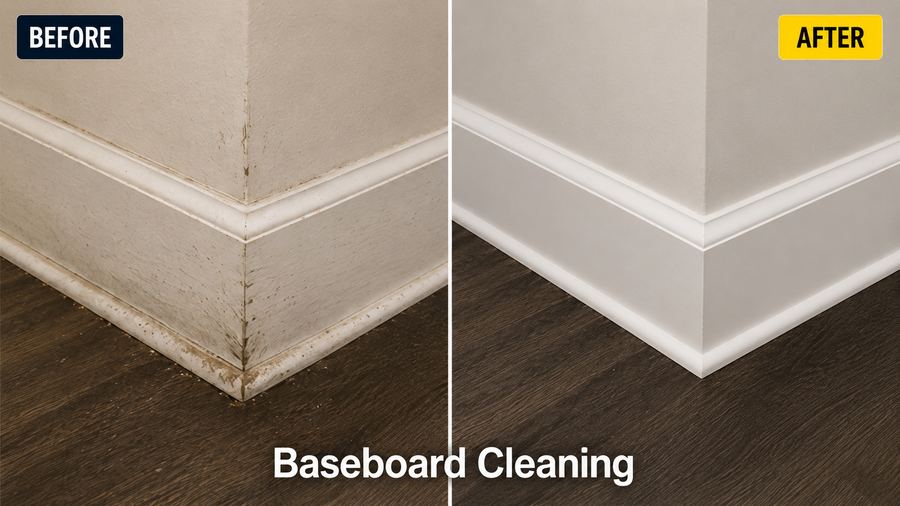
- Clean baseboard edges and corners with a crevice attachment.
- Vacuum behind open doors.
- Clean accessible areas under furniture without moving anything not previously arranged.
- Use appropriate attachments and settings for the specific flooring.
- Clean the open floor area with the standard vacuum head.
- Manage tools to prevent cross-contamination, following the standards above.
- Mop only when appropriate for that flooring type.
- Final inspection.
- Explain honestly any areas that were inaccessible or any permanent limitations we noticed.
A Field Example: How Access Determines Results
Two otherwise similar bedrooms illustrate how much access affects the outcome. In one room, the space around and under the bed was fully accessible — nothing stored underneath, furniture easy to reach around — and the crevice-to-floor process removed essentially all of the visible dust buildup along the edges and under the bed frame. In another room, the under-bed area was used for storage, with boxes and bins limiting what the vacuum attachment could reach without moving items that hadn't been arranged in advance.
The lesson isn't about one room being cleaner than the other — it's that access determines results far more than the cleaning method does. When homeowners let us know in advance which under-furniture areas they'd like accessible, we can plan for that; when storage or heavy furniture limits access, we clean everything we can safely reach and are upfront about what we couldn't get to.
North County San Diego Conditions
Cali Clean Team includes dust bunny prevention and removal as part of standard cleaning throughout North County San Diego, including San Marcos, Carlsbad, Oceanside, Vista, and Escondido. Pets, occupancy, activity level, flooring type, and cleaning frequency matter far more than which city a home is in — we haven't found meaningful differences in dust bunny formation based on location alone.
Preparing for Service
- [ ] Pick up clothing and toys from the floor
- [ ] Remove small items from floors and surfaces
- [ ] Clear accessible space under beds if that area should be cleaned
- [ ] Secure loose cords
- [ ] Move fragile objects out of the working area
- [ ] Secure pets during the visit
- [ ] Identify any furniture that should not be moved
- [ ] Disclose damaged floors or loose transition strips
- [ ] Mention any pest, lead, mold, or hazardous-dust concerns
- [ ] Confirm which under-furniture areas you'd like made accessible
Setting Realistic Expectations
Cleaning may improve loose dust, hair, pet fur, lint, crumbs, debris along baseboards, accessible material under furniture, and visible dust bunnies behind doors and in corners.
Cleaning may not fully address inaccessible spaces, dust under extremely heavy furniture, dust inside walls or HVAC systems, embedded carpet soil requiring specialty equipment, active pest contamination, medical allergy concerns, or reaccumulation caused by normal, ongoing household activity.
We don't promise that dust bunnies will never come back. Regular cleaning reduces buildup; it does not permanently stop normal household dust from forming.
Maintenance After Professional Cleaning
- Vacuum edges periodically, rather than waiting for visible buildup.
- Clean behind doors as part of your regular routine.
- Remove pet hair before it has a chance to compact.
- Keep under-bed storage organized so it stays accessible for future cleanings.
- Use appropriate filters and keep vacuum equipment well maintained.
- Replace or clean vacuum filters according to the manufacturer's guidance.
- Avoid over-wetting floors during routine mopping.
- Address any pest or hazardous conditions promptly, rather than waiting.
- Schedule recurring cleaning before buildup becomes severe — prevention is easier than restoration.
Local Relevance
Cali Clean Team includes dust bunny prevention and removal as part of every standard cleaning throughout North County San Diego. Whether you're in San Marcos, Carlsbad, Oceanside, Vista, or Escondido, the same crevice-to-floor process applies — pets, occupancy, and cleaning frequency matter far more than the specific neighborhood.
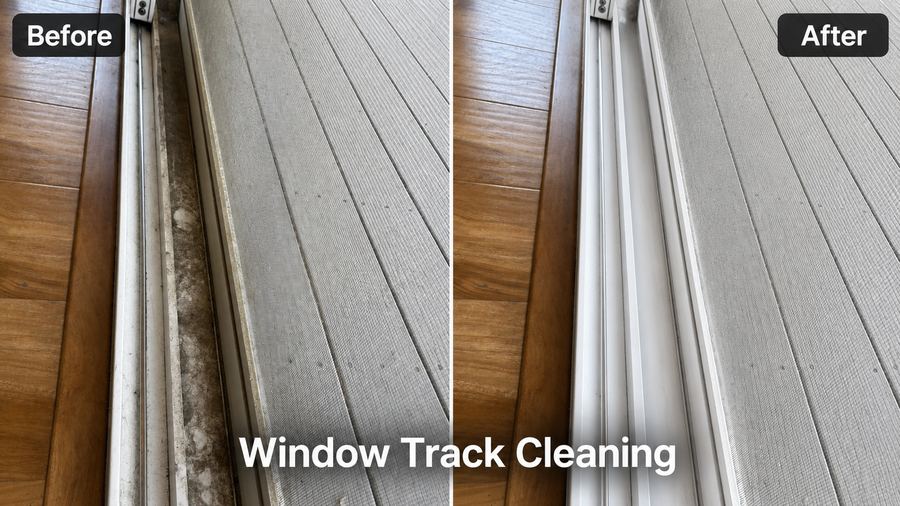
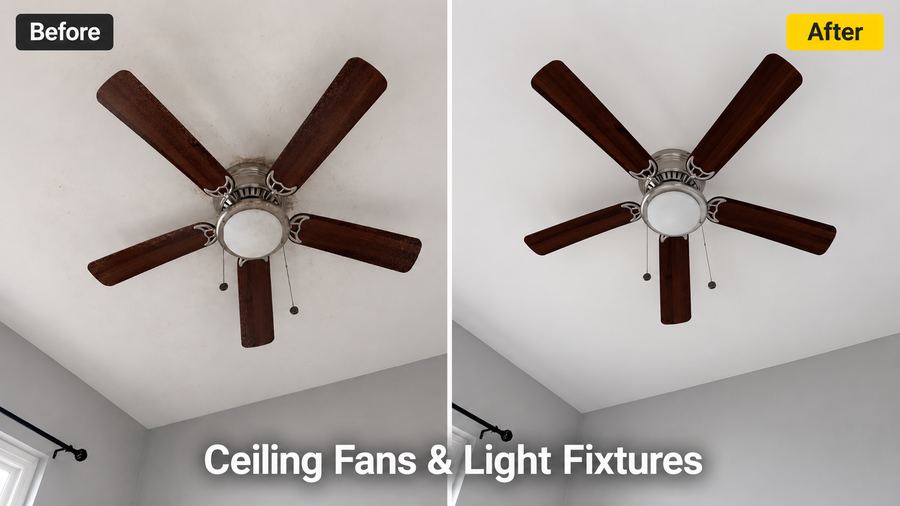
Dust bunny removal connects naturally to our baseboard and corner cleaning work and our window track cleaning guide, since all three rely on the same dry-debris-first philosophy. It's a standard part of our standard house cleaning and recurring cleaning, and commonly bundled into a broader deep cleaning or move-out cleaning. Our cross-contamination prevention standards directly inform how we manage tools during this service, and it pairs well with our ceiling fans and light fixtures and bathroom vent cleaning guide for a full top-to-bottom detail. Builders finishing a project can have it included in post-construction cleaning, and commercial spaces can find related guidance in our commercial cleaning services. Find your area on our San Marcos, Carlsbad, Oceanside, Vista, or Escondido service pages.