Baseboard Cleaning at a Glance
| Best For | Dusty trim, floor-edge buildup, pet hair along baseboards, and dust in decorative molding grooves |
| Routine-Service Type | Included in standard cleaning — loose dusting and accessible vacuuming |
| Deep-Clean Service Type | Hand-wiped detailing of compatible trim, grooves, and selected scuff treatment |
| Finish-Identification Requirement | Always — material and paint sheen are checked before any product or method is used |
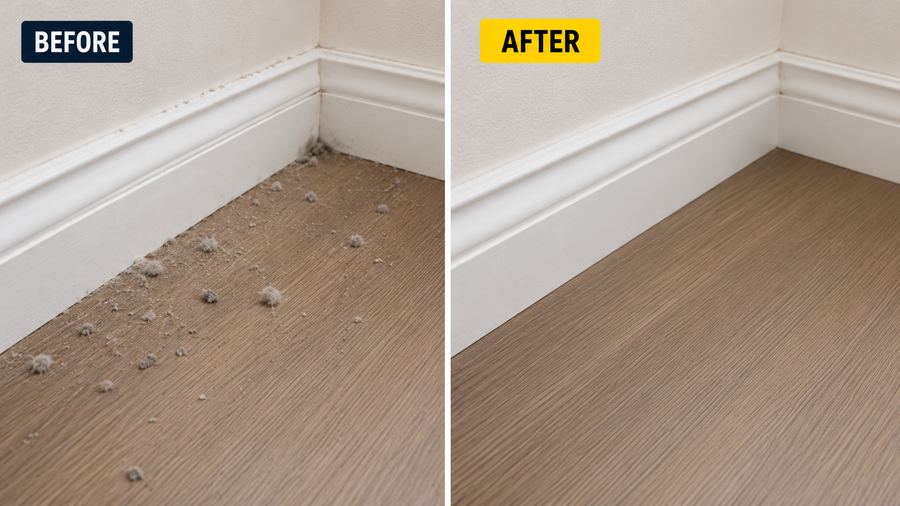
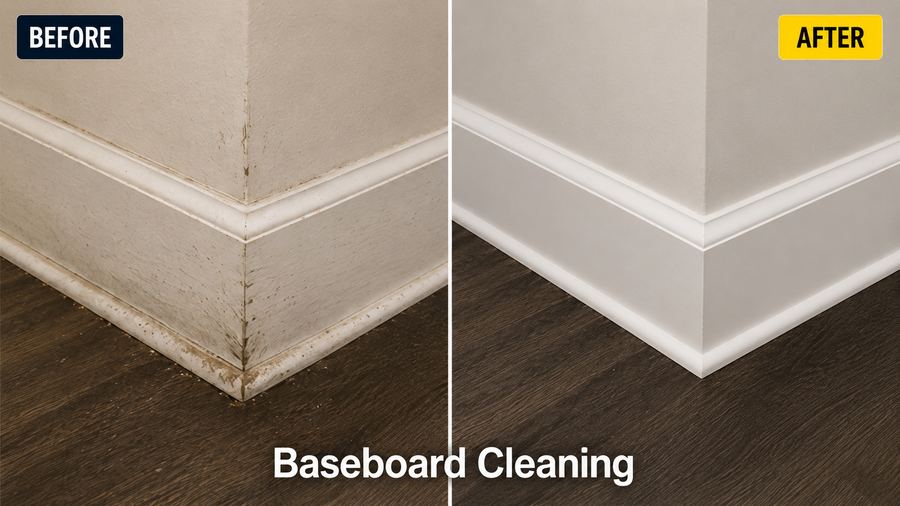
| What May Improve | Loose dust, pet hair, light grime, accessible corner buildup, dust in decorative profiles, some shoe scuffs and furniture-transfer marks |
| What May Remain | Chipped or burnished paint, permanent marker, deep scratches, gouges, swollen MDF, failed caulk, water stains, peeling paint, detached trim |
| Main Safety Rule | We start with the least aggressive compatible method and test before treating scuffs |
| What's Excluded | Recaulking, filling, repainting, replacing damaged trim, and mold or moisture-source diagnosis |
| When Service May Be Declined | Swollen or soft trim, active moisture, extensive mold-like growth, detached baseboards, or heavy furniture blocking safe access |
| Cities Served | San Marcos, Carlsbad, Oceanside, Vista, Escondido, and surrounding North County San Diego communities |
Why Baseboards and Corners Matter
Most people don't consciously look at baseboards when they walk into a room — instead, they notice the overall feeling of cleanliness. Dusty trim, visible dust lines, pet hair collecting at floor edges, and shadowed, neglected corners quietly create the impression that a home hasn't been thoroughly cleaned, even when everything else looks spotless. Decorative grooves and molding profiles collect dust in ways flat trim doesn't, and floor-edge buildup is often the first thing that makes an otherwise clean room look tired. That's why baseboard and corner attention is built into our process rather than treated as an afterthought.
Routine Cleaning vs. Deep Detailing vs. Repair
| Service Level | Typical Work | Main Goal | Main Limits |
|---|---|---|---|
| Routine maintenance | Loose dusting, accessible vacuuming, visible corner care | Prevent buildup | Doesn't include full hand wiping behind every object |
| Deep detailing | Hand-wiping compatible trim, detailed grooves, removable grime, selected scuffs | Improve neglected appearance | Depends on material, paint finish, and access |
| Repair or repainting | Recaulking, filling, repainting, replacing damaged trim | Correct physical or finish damage | Outside cleaning scope entirely |
To be clear about terminology: when we talk about "restoring" the appearance of trim, we mean improving how it looks through cleaning — not repainting or rebuilding it. Those are different services with different skill sets involved.
Baseboard and Trim Materials
| Material | Common Concern | Cleaning Sensitivity | Main Limitation |
|---|---|---|---|
| Painted wood | Chips, scuffs, dust in grain | Sensitive to sheen and paint age | Aggressive scrubbing can lift poorly bonded paint |
| MDF | Swelling from moisture | Very sensitive to standing water | Can swell or crumble if saturated |
| PVC | Generally durable | Low sensitivity | Still avoid harsh solvents |
| Vinyl | Generally durable | Low sensitivity | Avoid abrasive scrubbing on textured finishes |
| Stained wood | Fading, finish wear | Sensitive to solvents | Avoid products that strip the stain/sealant |
| Natural wood | Moisture sensitivity, finish wear | High sensitivity | Avoid standing water and harsh chemicals |
| Tile | Grout staining | Generally durable | Grout is porous; test cleaners first |
| Stone | Etching from acidic cleaners | Sensitive to acids | Avoid acidic products entirely |
| Metal | Corrosion, scratching | Varies by finish | Avoid abrasives on coated metal trim |
| Decorative composite molding | Dust in detailed profiles | Varies by manufacturer | Deep grooves need smaller, gentler tools |
Identifying the material comes before selecting how much moisture, what cleaner, or how much abrasion is appropriate — treating every trim type the same way is one of the most common ways damage happens.
Why Paint Sheen Changes What Can Be Cleaned
Not all painted baseboards can be treated the same way, and sheen matters as much as color:
- Flat and matte paint can burnish (develop a shiny patch), lose pigment, or show water marks when scrubbed, even gently.
- Eggshell and satin vary widely depending on the specific product and how long ago it was applied — some hold up well, others don't.
- Semi-gloss and gloss are usually more washable, but they can still scratch with the wrong tool or abrasive.
- Old or poorly bonded paint may lift regardless of sheen, especially if it wasn't properly prepped or primed originally.
- Touch-up paint can react differently than the surrounding original finish, even if it looks like a color match.
- A test area may be needed before we commit to a cleaning method on trim we're not familiar with.
Dirt, Scuffs, Stains, or Damage?
| Condition | What It May Look Like | May Cleaning Improve It? | When Is Repair/Repainting Needed? |
|---|---|---|---|
| Loose dust | Visible dust along the trim surface | Yes | Rarely |
| Pet hair | Hair collecting at the floor-baseboard seam | Yes | Rarely |
| Oily soil | General dulling or greasy film | Often, yes | Rarely |
| Shoe scuff | Dark rubber marks near the floor | Often, yes | Occasionally, if deeply set |
| Furniture transfer | Marks from contact with furniture | Often, yes | Occasionally |
| Paint transfer | Color transferred from another surface | Sometimes | Sometimes |
| Water staining | Discoloration, sometimes with texture change | Rarely, cosmetically | Often — source needs addressing first |
| Mold-like spotting | Dark or fuzzy spots | No | Yes — remediation evaluation needed |
| Chipped paint | Visible bare trim or missing paint | No | Yes — repainting |
| Gouges | Physical indentation in the trim | No | Yes — repair |
| Swollen MDF | Trim appears puffy, soft, or separated | No | Yes — moisture source addressed, then replacement |
| Failed caulk | Gaps or cracking where trim meets wall/floor | No | Yes — recaulking |
| Detached trim | Trim pulling away from the wall | No | Yes — repair |
We're not diagnosing mold species or the exact source of moisture here — we simply recognize when a condition is outside what cleaning can address and say so honestly.
What Scuff Removal Really Involves
Marks on baseboards can come from a lot of different sources — shoe scuffs, furniture transfer, rubber marks, crayon, marker, paint transfer, adhesive residue, or in some cases, permanent finish damage that just looks like a mark.
Here's how we approach it:
- We start with the least aggressive compatible method for that surface, not the strongest one available.
- Melamine foam (the material in "eraser" style cleaning pads) is mildly abrasive — it works by gently sanding away the top layer of a mark, which means it can also dull paint or remove pigment if used too aggressively or on the wrong finish.
- It's used only after testing an inconspicuous area, when that's appropriate for the specific paint and sheen.
- Some marks are better left alone than risking finish damage trying to fully remove them.
- In some cases, repainting is genuinely the only way to fully resolve a mark — and we'll tell you that rather than over-scrubbing to chase a result that isn't coming.
We don't treat melamine foam pads as universally safe on every painted surface — the same product that works beautifully on semi-gloss trim can burnish flat paint in the wrong hands.
Moisture Damage: What We Can and Can't Address
Swollen, soft, separated, or stained trim can be a sign of an underlying moisture problem — not just a cleaning issue. Possible sources include plumbing leaks, wet mopping habits, pet accidents, shower or toilet leakage, exterior water intrusion, or ongoing condensation.
Cleaning cannot correct the actual source of moisture. Soft or crumbling material may not even be safe to scrub without causing further damage. Active moisture needs to be repaired before cosmetic cleaning makes sense — otherwise we're cleaning around a problem that will just come back. We don't diagnose mold species or structural damage, and recaulking, repainting, or trim replacement are outside our scope unless separately offered and arranged as a distinct service.
Protecting Adjacent Flooring
Different flooring types call for different levels of caution when we're cleaning the baseboard right above them:
- Hardwood — moisture is used sparingly to avoid damage at the seam.
- Laminate — similarly moisture-sensitive; standing water is avoided.
- Luxury vinyl — generally more forgiving, but harsh solvents are still avoided.
- Carpet — edges are not saturated; over-wetting can wick into the carpet fibers and cause its own problems.
- Tile — generally durable, though grout lines nearby are treated carefully.
- Natural stone — acidic products are avoided entirely near stone flooring.
- Grout — porous and prone to staining; tested before broader product use.
- Painted floors — treated with the same caution as painted trim.
Product is controlled to avoid pooling at seams, wet methods are adjusted to the specific flooring beneath, and solvents or abrasives that could damage an adjacent surface are avoided. Loose transitions or already-damaged flooring may limit how aggressively we can safely clean that specific area.
Furniture and Access Boundaries
Normally accessible:
- Exposed trim
- Behind open doors
- Visible corners
- Areas reachable with standard attachments
- Spaces beneath raised furniture where our tools fit safely without moving anything
May be addressed when easy and safe:
- Lightweight chairs
- Small bins
- Simple movable decor
- Furniture that's already pulled away from the wall
Requires advance arrangement or remains excluded:
- Beds
- Heavy sofas
- Large dressers
- Entertainment centers
- Fragile antiques
- Furniture with electronics or cables attached
- Anchored furniture
- Items likely to damage flooring, walls, or trim if moved
To be direct: not all furniture is moved during a deep clean. If you'd like specific pieces moved to access baseboards behind them, that needs to be discussed and arranged in advance.
What Corner-Detail Cleaning Actually Includes
Accessible corner detail may include floor corners, baseboard returns, behind doors, baseboard-to-floor seams, trim grooves, door-casing corners, transition edges, accessible caulk lines, and cobweb or loose-dust removal. To be clear about the boundary here: full wall washing, door restoration, caulk replacement, and paint repair are separate services, or outside our scope entirely — corner-detail cleaning addresses the accessible dirt and dust in these areas, not structural or finish repairs.
Cross-Contamination Standards
The same principles from our cross-contamination prevention guide apply directly here:
- Floor-level tools remain floor-level tools.
- Bathroom floor-edge tools are handled separately from living-area tools.
- Loose dust is removed before any wet wiping begins.
- Cloths and brushes are changed as needed throughout the job.
- Vacuum attachments are checked before use.
- Dirty floor tools don't touch furniture, counters, or upper surfaces.
- Trim that's already been cleaned isn't recontaminated during subsequent floor cleaning.
Decorative Trim and Detailed Profiles
Decorative molding takes real extra time compared to flat trim. Grooves collect dust that flat baseboards simply don't, and pet hair often catches at transitions between different profile depths. Detailed molding may require smaller brushes to get into the grooves properly, and fragile or poorly bonded paint limits how much agitation we can safely use in those recesses. Ornate trim takes longer than flat trim, and the depth of the profile directly affects how thorough a result is realistically achievable.
Is Professional Baseboard Cleaning Right for You?
It may be useful if:
- Dust lines are visible around your rooms.
- Pet hair collects consistently at floor edges.
- Decorative trim has visibly dusty grooves.
- Corners have been missed repeatedly by routine cleaning.
- You're scheduling a deep clean.
- You're preparing for a move-in or move-out that needs edge detailing.
- The marks you're seeing appear removable rather than physically damaged.
It may not be the correct service if:
- Trim is swollen or soft.
- Paint is visibly peeling.
- There's active moisture present.
- Mold-like growth is extensive.
- Baseboards are detached from the wall.
- Deep gouges or broken trim are present.
- What's actually needed is repainting or recaulking.
- Heavy furniture blocks access that hasn't been arranged for in advance.
DIY vs. Professional Cleaning
DIY may be appropriate for:
- Routine dusting.
- Known, washable paint you're already familiar with.
- Light grime.
- Easily accessible trim.
- Homeowners using manufacturer-compatible cleaning methods.
Professional detailing may be useful for:
- Whole-home baseboard detailing in one visit.
- Decorative profiles that take extra time and the right tools.
- Heavy buildup that's accumulated over a long time.
- Homes with multiple flooring types requiring different caution levels.
- Deep cleaning projects generally.
- Move-out cleaning where detail matters.
- Situations where paint compatibility is uncertain.
- Furniture-access planning across a whole home.
There's no shame in handling routine dusting yourself — this guide is about recognizing when a more careful, whole-home approach adds real value.
How Cali Clean Team Cleans Baseboards and Corners
We inspect before we clean, and our approach follows top to bottom, left to right — always aiming to leave every room looking cared for from the floor up.
- Confirm the scope of the service.
- Inspect trim material, paint sheen, and any existing damage.
- Identify the adjacent flooring to determine safe moisture levels.
- Check access and furniture limitations.
- Remove loose dust and pet hair first, before introducing any moisture.
- Vacuum edges and corners.
- Test a small area when needed, especially for unfamiliar paint or trim.
- Use the least aggressive compatible cleaner for that surface.
- Hand wipe during deep detailing, where that's appropriate and included in scope.
- Clean decorative grooves with compatible tools sized for the profile.
- Spot-treat removable scuffs carefully, testing first.
- Control moisture around flooring and seams throughout.
- Change floor-level tools as needed to prevent cross-contamination.
- Final inspection under good lighting.
- Explain permanent damage or repair needs honestly.
We don't hand-wipe every baseboard during every single service — that level of detail is part of deep cleaning specifically, not every routine visit.
Setting Realistic Expectations
Cleaning may improve: loose dust, pet hair, light grime, accessible corner buildup, dust in decorative profiles, some shoe scuffs, some furniture-transfer marks, and light residue along seams.
Cleaning may not correct: chipped paint, burnished paint, permanent marker, deep scratches, gouges, swollen MDF, failed caulk, water stains, peeling paint, detached trim, mold damage, or permanent discoloration.
We don't promise "like new" — we promise a genuinely thorough cleaning of what's actually removable, and an honest answer when something isn't.
Preparing for Service
- [ ] Remove small items from floor edges
- [ ] Pick up cords and pet toys
- [ ] Identify any furniture that should not be moved
- [ ] Mention any active leaks or prior water damage
- [ ] Disclose fragile, fresh, or touch-up paint
- [ ] Identify any specialty wood or stone trim
- [ ] Secure pets during the visit
- [ ] Note any known permanent marker, adhesive, or paint transfer marks
- [ ] Let us know which blocked areas you'd like accessed, if any
- [ ] Please avoid applying unknown products to trim immediately before your service
Maintenance After Cleaning
- Dust regularly, rather than waiting for visible buildup.
- Vacuum pet hair from edges as part of routine upkeep.
- Wipe spills promptly.
- Avoid excessive wet mopping directly against trim.
- Use paint-compatible products for your specific finish.
- Keep cloths free of trapped grit.
- Address leaks quickly rather than letting them linger near trim.
- Avoid aggressive scuff-removal attempts that risk the finish.
- Repaint chipped or permanently marked trim when cleaning genuinely can't resolve it.
- Maintain decorative grooves before buildup has a chance to harden.
Routine maintenance meaningfully reduces the need for aggressive cleaning later, but we're not going to promise that any cleaning routine prevents all damage — some of it comes down to material age, paint quality, and moisture exposure outside anyone's control.
Local Relevance
Cali Clean Team cleans baseboards, trim, and corners throughout North County San Diego, including San Marcos, Carlsbad, Oceanside, Vista, and Escondido. Trim condition tends to depend far more on pets, maintenance habits, flooring type, paint quality, and access than on which city a home is in.
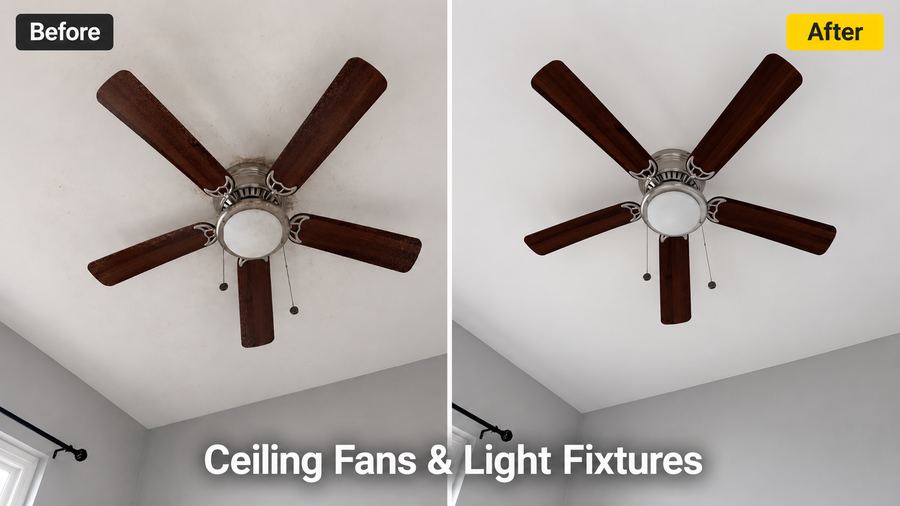
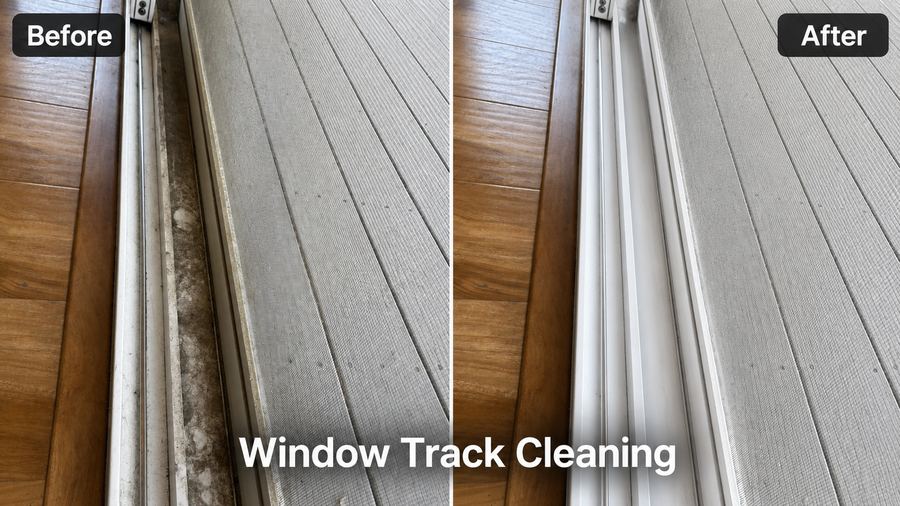
Baseboard cleaning connects naturally with our dust bunny removal guide and window track cleaning guide, which share the same dry-debris-first, material-aware philosophy. Our cross-contamination prevention guide informs how we manage floor-level tools during this service, and newly painted trim after a renovation is addressed with the same care described in our post-construction cleaning guide. It's included in standard house cleaning and expanded during deep cleaning and recurring cleaning, and commonly part of move-out cleaning. Find your area on our San Marcos, Carlsbad, Oceanside, Vista, or Escondido service pages.