Post-Construction Cleaning at a Glance
| Best For | Homes and projects finishing a remodel, addition, or new construction that need a staged final clean before handoff |
| Primary Audiences | Homeowners completing a renovation, and general contractors/builders coordinating final cleanup |
| Walkthrough Requirement | Mandatory — every project is estimated individually after an in-person walkthrough, since no two projects are alike |
| Cleaning Phases | Rough clean, detailed clean, and final/touch-up clean — not every project includes all three unless specified in the proposal |
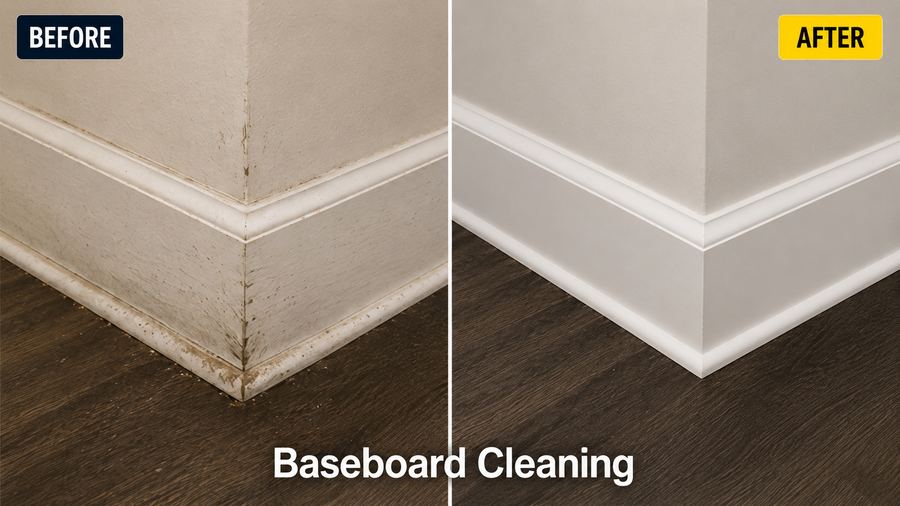
| What May Be Included | Cabinet and drawer interiors, window and track detailing, wall wiping, trim/ledges/baseboards, fixtures, floors (cleaned last) |
| What's Excluded | HVAC duct cleaning, hazardous-material remediation, environmental/air-quality testing, structural repairs, and correcting contractor-caused damage |
| HEPA-Filtration Role | One part of an agreed dust-control plan when included — not a certification that a space is free of silica, lead, asbestos, or other hazards |
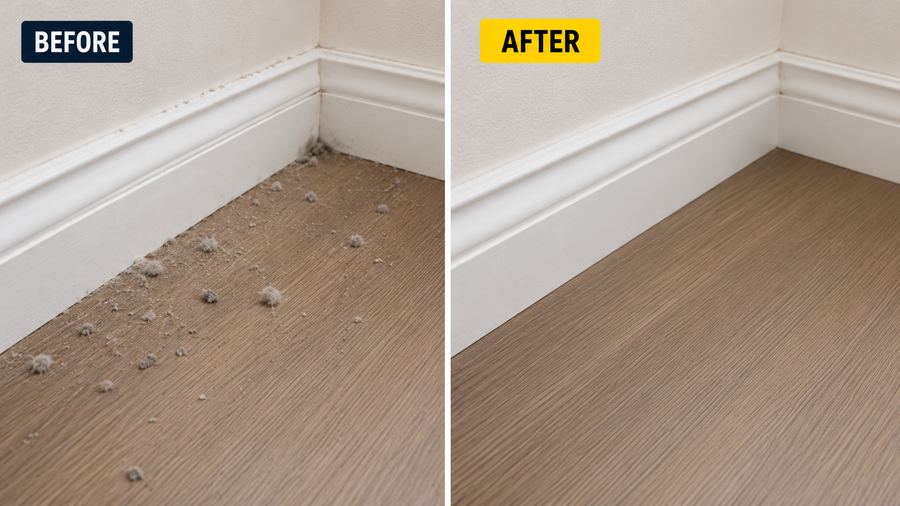
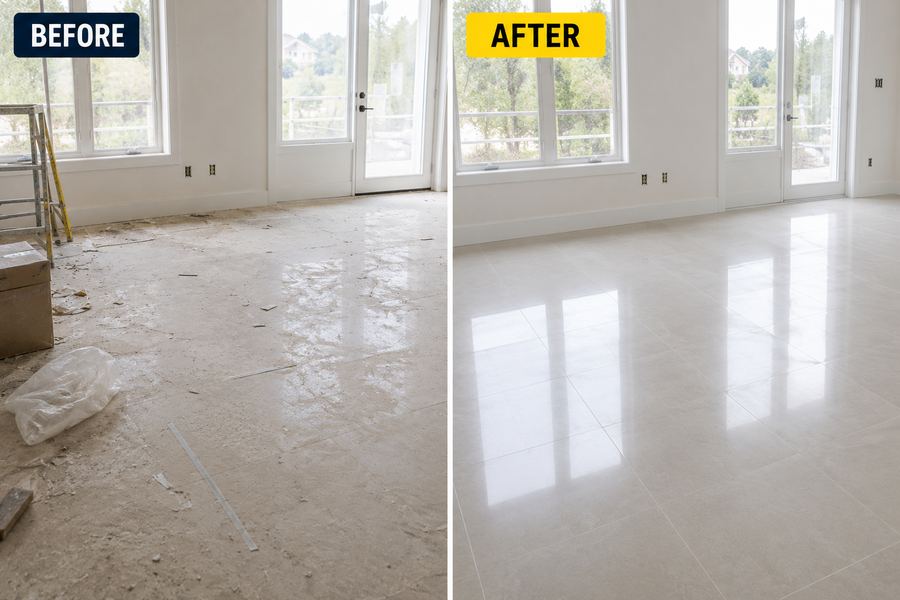
| What May Improve | Settled dust, fingerprints, light adhesive residue, compatible stickers, cabinet dust, window-track debris, light surface film |
| What May Remain | Scratched floors, etched glass, paint defects, damaged cabinetry, incorrect caulk, bonded overspray, corroded fixtures, improper installation |
| When Service May Be Declined | Known or suspected asbestos, lead, significant silica contamination, mold, sewage, chemical spills, active demolition dust, or inadequate containment |
| Cities Served | San Marcos, Carlsbad, Oceanside, Vista, Escondido, La Jolla, and surrounding North County San Diego communities |
Why Post-Construction Cleaning Is Different
Post-construction cleaning isn't a bigger version of a deep clean. It involves fine dust that doesn't behave like everyday household dust — it can settle unevenly, hide inside cabinetry and drawers, and continue resettling for days after the main work is done. New finishes need to be identified and protected before anything touches them. Multiple trades may have left behind different kinds of residue. And the stakes are different too: for homeowners, this is often the final impression of a major investment; for contractors, it's part of their reputation and handoff standard with their own client.
Types of Construction Dust
Not all construction dust is the same, and it's worth understanding the range of what a construction site can generate:
- General household and construction dust
- Drywall-sanding dust
- Wood dust
- Concrete and masonry dust
- Potential crystalline silica (from cutting, grinding, or sanding certain materials)
- Lead dust, particularly in properties built before 1978
- Fiberglass or insulation debris
- Paint and coating residue
- Unknown powders or other hazardous material
The type of dust present depends entirely on the materials and activities involved in that specific project. Silica cannot be identified visually — you can't look at a pile of dust and know whether it contains crystalline silica. Drywall dust is not automatically silica dust, either; the two get conflated often, but they're not the same thing. Contractors should disclose what materials have been cut, sanded, or otherwise disturbed during the project, since that informs what precautions are appropriate. When a hazard is suspected, testing or an industrial-hygiene evaluation may be required before we proceed — we're not equipped to diagnose a contaminant by appearance, and we won't pretend otherwise.
HEPA Filtration, Vacuums, and Air Management
Portable HEPA air-filtration devices may help reduce airborne particulate levels during a construction cleanup. That's a genuinely useful tool — but it's one part of a broader dust-control plan, not a standalone solution and not a certification of anything.
A few things worth understanding clearly:
- Performance depends on the equipment's capacity, its placement in the room, the room's volume, the condition of its filter, and how long it runs.
- HEPA filtration does not replace source control, proper containment, or actual surface cleaning — it addresses airborne particles, not what's already settled on surfaces.
- It does not certify a property as free from silica, lead, asbestos, or any other hazard.
- We do not perform air-quality certification or industrial-hygiene testing — that requires a different kind of professional entirely.
Depending on the project, portable HEPA filtration may be used before, during, or after detailed cleaning, as part of the dust-control plan we agree on during the walkthrough — we're not going to claim every project automatically begins with air scrubbing, since that depends on the specific job.
On vacuum equipment: fine construction dust calls for vacuum equipment appropriate to that dust and its exposure risk. An ordinary shop vacuum is not treated as appropriate for fine dust simply because a filter has been added to it — attaching a HEPA-style filter to a standard vacuum doesn't automatically make it a true HEPA vacuum. Filters and collection bags are handled carefully to avoid unnecessarily releasing dust back into the air. If a site presents hazardous-dust conditions, that may fall outside our scope entirely.
[Publisher note: confirm the actual vacuum models and filter specifications currently used by Cali Clean Team before publishing any specific equipment claims. This guide intentionally avoids naming specific equipment until that's verified.]
How Dust Is Actually Removed
We don't rely on feather dusters or aggressive dry brushing as a default approach for construction dust — those methods tend to resuspend fine particles rather than capture them. Instead, dust removal may include:
- HEPA-filtered vacuuming with compatible attachments
- Controlled microfiber wiping
- Damp wiping, when that's safe for the specific finish
- Low-agitation methods generally
- Multiple passes where needed
- Fresh cloths and pads throughout
- Working from high surfaces down to low ones
The goal throughout is capturing dust rather than stirring it back into the air.
Rough, Detailed, and Final Cleaning
| Phase | Main Objective | Typical Work | When It Occurs |
|---|---|---|---|
| Rough clean | Remove larger debris and create access | Packaging, loose debris, protective material removal, initial dust reduction | After major construction work is done |
| Detailed clean | Clean all agreed surfaces systematically | Cabinets, fixtures, walls, trim, windows, tracks, rooms, and floors | After dust-generating trades are substantially complete |
| Final / touch-up clean | Prepare for handoff | Fingerprints, punch-list dust, resettled particles, final floors | After final trade work, or shortly before turnover |
Not every project includes all three phases — what's included is defined in the proposal following the walkthrough, since some projects need only a subset of this process.
Is the Site Ready for Final Cleaning?
Before final cleaning can proceed effectively, we look for:
- [ ] Cutting and sanding are complete
- [ ] Trades have removed their tools and excess material
- [ ] Construction debris is removed, or explicitly included in our scope
- [ ] Paint, caulk, and coatings are sufficiently cured
- [ ] Protective films are ready to be removed
- [ ] Electricity, water, and lighting are available
- [ ] HVAC operation and containment have been discussed
- [ ] Areas are safely accessible
- [ ] Punch-list work has been identified
- [ ] No uncontrolled dust-producing work is still occurring
Cleaning before a site is genuinely ready can lead to rework and added cost — dust from ongoing trades will simply undo detailed cleaning that's already been completed.
Containment Expectations
Contractors are expected to isolate active work zones during construction. Doorways, HVAC returns, furnishings, and adjacent occupied spaces should be protected when appropriate throughout the project — not just at the end. Poor containment during construction can significantly increase the scope (and cost) of final cleaning, since dust that's spread throughout a home is much more labor-intensive to address than dust that stayed contained to the work zone. Final cleaning cannot fully compensate for uncontrolled dust migration that happened during construction. If dust-generating trades return to the site after cleaning is complete, that will likely require another visit — we're not providing contractor regulatory guidance here, just describing how containment affects our side of the process.
Worker Safety and PPE
Personal protective equipment depends on the dust, the product, the specific site, and the employer's own safety procedures. A generic dust mask is not automatically adequate for hazardous dust. Respirator use may require a hazard assessment, fit testing, training, and a written program, depending on the situation — this isn't something we're going to reduce to a simple recommendation in a guide like this one. We don't publish universal respirator guidance, and unsafe sites are declined until the conditions are corrected.
When Post-Construction Dust Requires a Specialist
Some conditions go beyond what post-construction cleaning is equipped to address:
- Known or suspected asbestos
- Lead dust
- Significant crystalline silica contamination
- Mold
- Sewage
- Chemical spills
- Fiberglass or insulation contamination beyond normal scope
- Hazardous coatings
- Unknown powders
- Active demolition dust
- Sites without adequate containment
- Conditions that call for environmental testing
In any of these situations, we may pause the project, decline the work, request contractor correction first, require testing, or refer the job to a remediation or industrial-hygiene professional. We're not claiming remediation capability — our role is cleaning, not hazard abatement.
Is Professional Post-Construction Cleaning Right for the Project?
It may be appropriate if:
- Dust-producing work is substantially finished.
- The property is safely accessible.
- The scope of remaining construction debris is clearly defined.
- Cabinets, fixtures, and finished surfaces need detailing.
- A contractor handoff is approaching.
- The project requires a staged cleaning approach across phases.
- Materials used and any known hazards have been disclosed.
It may not be appropriate yet if:
- Demolition or sanding is still active.
- Hazardous dust is suspected.
- Lead or asbestos work is unresolved.
- Utilities aren't yet available on-site.
- Finishes haven't sufficiently cured.
- Contractors are continuing uncontrolled dust-generating work.
- Sewage, mold, or chemical contamination is present.
- The site isn't currently safe to work in.
How Cali Clean Team Plans the Project
- Walkthrough — mandatory, in person, before any pricing.
- Scope documentation — what's included, what isn't.
- Dust and hazard disclosures — materials cut, sanded, or disturbed.
- Finish identification — cabinetry, countertops, flooring, fixtures.
- Equipment access — utilities, parking, staging area.
- Cleaning phases — which of rough/detailed/final apply to this project.
- Contractor schedule — coordinating around remaining trade work.
- Touch-up expectations — whether a return visit is included.
- Exclusions — clearly stated in the proposal.
- Proposal approval — before work begins.
How Cali Clean Team Performs Detailed Cleaning
We inspect before we clean, and we follow top to bottom, left to right — adjusted as needed for the specific project's layout and hazards.
- Confirm the site is ready, per the readiness checklist above.
- Review hazards and scope with the contractor and/or homeowner.
- Protect completed finishes before starting.
- Use appropriate air filtration when included in the agreed plan.
- Remove dust from high surfaces using controlled, low-agitation methods.
- Clean vents only at the visible surface — never inside HVAC ductwork, which requires a licensed HVAC specialist.
- Detail fixtures and architectural features.
- Clean trim, frames, ledges, and baseboards.
- Clean cabinet and drawer interiors, when included in scope.
- Clean windows and tracks.
- Clean compatible walls, using methods appropriate to the finish.
- Clean bathrooms and kitchens, following the same detailed process used throughout our other services.
- HEPA vacuum appropriate surfaces.
- Mop using finish-compatible methods.
- Remove compatible residue carefully — adhesives, caulk smears, stickers — only where it's safe for that finish.
- Final inspection.
- Document any damage or unfinished work we notice.
- Complete the agreed final touch-up, if that's part of the scope.
Most cleaners see surfaces. We see craftsmanship — which is part of why we identify the finish before we ever touch it with a product.
Surface and Finish Protection
| Surface | Cleaning Note |
|---|---|
| Fresh paint | Cure time matters significantly before any wiping or product contact |
| Cabinet finishes | Vary widely by manufacturer; test spots may be needed before broader application |
| Natural stone | Acid-sensitive; avoid acidic cleaners entirely |
| Engineered stone | Generally more resistant, but still avoid harsh solvents |
| Hardwood | Sensitive to standing moisture; controlled, low-moisture methods only |
| Luxury vinyl | Generally durable, but still avoid harsh solvents on seams |
| Tile and grout | Grout is porous and can stain; test cleaners on an inconspicuous area first |
| Glass | Avoid abrasive scrubbing that can create fine scratches |
| Stainless steel | Clean with the grain; avoid abrasive pads |
| Matte fixtures | Show fingerprints and scratches easily; avoid anything abrasive |
| Custom wood | Treated as architectural craftsmanship, not just a surface — extra care and, where appropriate, finish-specific products |
| Acrylic and plastics | Can scratch or cloud with the wrong product; avoid harsh solvents |
Adhesives, caulk, and stickers are removed only when it's safe for that specific finish — solvents and scrapers are never treated as universal tools. Cure time matters, test spots may be required before broader application, and contractor-caused damage (a scratch, an installation defect) is not the same thing as removable residue that cleaning can address. When a finish is scratched, etched, or improperly installed, that calls for a repair, not more aggressive cleaning.
What Cleaning Can — and Cannot — Fix
| Cleaning May Remove | Cleaning Cannot Repair |
|---|---|
| Drywall dust | Scratched floors |
| General settled dust | Etched glass |
| Fingerprints | Paint defects |
| Light adhesive residue | Damaged cabinetry |
| Compatible stickers | Incorrect caulk |
| Cabinet dust | Overspray that has bonded permanently |
| Window-track debris | Corroded fixtures |
| Light surface film | Broken hardware |
| Contractor hand marks | Improper installation |
| Hazardous contamination | |
| Unfinished construction |
Contractor and Builder Partnerships
We work directly with general contractors and builders on final cleaning as a distinct phase of the project — not an afterthought. That includes joining the walkthrough, keeping scope clear in writing, coordinating our schedule around remaining trades, understanding handoff standards and punch-list timing, and communicating clearly if trades return after our cleaning is complete (which typically means a change order for an additional visit, not a silent redo).
We take seriously that when a contractor hires us, we're representing their craftsmanship to their client — the quality of the handoff reflects on the builder as much as it does on us.
A Real Case Study: Protecting Craftsmanship During a La Jolla Remodel
One of the most memorable post-construction projects we've completed was a large luxury home remodel in La Jolla — at the time, the largest remodel we'd undertaken, and one of the dustiest. Although the renovation itself was beautifully executed, construction dust had migrated throughout the home, including into a decorative fireplace detail that hadn't been adequately protected during construction and required careful, finish-specific cleaning.
One of the home's most distinctive features was a custom architectural wood door that initially looked like it might be beyond saving — heavily affected by construction dust and residue. Rather than treating it like an ordinary door, we recognized it as a handcrafted feature and used careful, finish-appropriate dust removal to bring back its appearance without damaging the underlying craftsmanship. To be clear about what that means: this was a cleaning and finish-restoration process, not a structural repair — we didn't fix anything mechanically wrong with the door, we carefully removed dust and residue and restored the visible finish.
Although we'd been hired by the general contractor, the homeowners were impressed enough with the attention to detail that they later contacted us directly for additional work. That experience reinforced something we believe strongly: representing a builder's craftsmanship well is about far more than removing dust — it's about earning a homeowner's confidence through care and attention to detail.
[Publisher note: this case study should not include invented project value, square footage, dates, or customer identity. Any photos require confirmed approval, and if a direct homeowner quote is used, its exact wording and permission to publish must be verified first.]
What "Move-In Ready" Actually Means
The goal of our service is a clean, presentation-ready handoff within the agreed scope — that's the honest way to describe what post-construction cleaning delivers.
Occupancy or safety decisions for the property may still depend on things entirely outside our scope: contractor completion of remaining work, building inspection, environmental testing, repairs, HVAC work, curing time, hazard clearance, and the homeowner's own final approval. We're not claiming the property is certified safe for occupancy — that determination involves other professionals and processes beyond a cleaning service.
Setting Realistic Expectations
Cleaning time varies significantly by project size and condition — we don't quote a fixed time in this guide, since it depends entirely on what we find during the walkthrough. Multiple phases may be needed depending on the project. Fine dust may continue to resettle for a few days after the main cleaning is complete, and this doesn't automatically mean the initial cleaning failed — it's a natural part of how construction dust behaves. Additional trade work returning to the site may require a touch-up visit. Permanent damage — paint defects, scratched floors, improperly installed materials — remains permanent regardless of cleaning. Air filtration is a tool, not an air-quality certification. And move-in readiness ultimately depends on the full project, not cleaning alone.
Maintenance After Handoff
- Light HEPA vacuuming where appropriate, rather than dry sweeping.
- Damp wiping compatible surfaces as part of routine upkeep.
- Replace HVAC filters according to qualified guidance from an HVAC professional.
- Avoid unnecessary dry dusting that can resuspend fine particles.
- Monitor for resettled dust over the first few days.
- Schedule a touch-up visit if one is included in your proposal, or if needed.
- Report any leaks or construction defects to your contractor promptly.
- Protect newly cleaned areas if trades are still returning to finish work.
Local Relevance
Cali Clean Team performs post-construction cleaning throughout North County San Diego, including projects in San Marcos, Carlsbad, Oceanside, Vista, Escondido, and luxury remodels in coastal communities like La Jolla. Project conditions — dust type, finish sensitivity, containment quality — are determined by the specific project and materials involved, not by neighborhood. Every project, regardless of location, starts with the same mandatory walkthrough.
Post-construction cleaning connects naturally to our window track cleaning guide and dust bunny removal guide, both of which share the same dry-debris-first philosophy. Our cross-contamination prevention guide informs how we manage tools across a multi-room construction site, and finish-specific care carries into our stainless steel care, oven cleaning guide, and refrigerator cleaning guide for newly installed appliances. It's commonly paired with a broader deep cleaning or scheduled ahead of move-out cleaning for a renovated rental. Commercial build-outs can find related guidance in our commercial cleaning services, and general information is on our house cleaning page or your local San Marcos, Carlsbad, Oceanside, Vista, or Escondido service page.