
Commercial Cleaning at a Glance
| Best For | Offices, clinics, retail stores, restaurants, and commercial properties needing a documented, consistent cleaning system |
| Primary Audiences | Business owners, office managers, clinic administrators, retail managers, restaurant operators, property managers |
| Walkthrough Requirement | Mandatory — every account starts with an in-person walkthrough before a proposal is built |
| Service-Plan Requirement | A written, site-specific checklist defining every-visit, rotational, and periodic tasks |
| Typical Scheduling | Varies by facility — daily, several times weekly, weekly, or periodic, depending on traffic and use |
| What May Be Included | Restrooms, floors, trash, break rooms, entry areas, and agreed high-touch surfaces |
| What's Excluded | Medical terminal cleaning, hood-duct/exhaust cleaning, biohazard remediation, and repair of any kind |
| What's Customized | The checklist, frequency, supply responsibilities, and access procedures — built during the walkthrough, not assumed |
| Main Quality-Control Principle | A named client contact, a written checklist, and a clear process for reporting and correcting missed tasks |
| When Service May Be Declined | Biohazard conditions, active sewage, hazardous chemicals, or facilities that can't provide safe access |
| Cities Served | San Marcos, Carlsbad, Oceanside, Vista, Escondido, and surrounding North County San Diego communities |
What Professional Commercial Cleaning Means
Professional commercial cleaning is a documented, site-specific system for maintaining customer-facing, employee, restroom, floor, and common areas according to an agreed schedule and written scope.
It's not one generic checklist applied identically to every business. A medical office, a retail store, and a restaurant have almost nothing in common in terms of what needs attention — but the underlying operating principles (a mandatory walkthrough, a written checklist, consistent scheduling, and clear communication) stay the same across all of them.
Why Employee Tidying Is Not a Janitorial Program
Employees can handle small day-to-day tidying tasks, but consistent facility cleaning requires dedicated time, clear responsibility, proper tools, suitable products, and a written system. This isn't a suggestion that employees don't care or lack ownership of their workspace — it's that cleaning wasn't the job they were hired for, and asking them to also maintain a full facility on top of their actual responsibilities creates ambiguity about who's actually responsible for what. Professional cleaning removes that ambiguity by assigning it to a dedicated system instead of hoping it gets handled between other tasks.
How Commercial Facilities Differ
| Facility Type | Typical Priorities | Main Risks or Sensitivities | Common Scope Limits |
|---|---|---|---|
| Office | Desks, restrooms, break rooms, floors, entry | Electronics, confidential materials, employee belongings | No document handling or equipment repair |
| Retail | Entry, counters, fitting rooms, glass, floors | Customer traffic, merchandise, security | No merchandise movement without approval |
| Medical/dental office | Waiting room, restrooms, offices, nonclinical areas | Bodily fluids, sharps, medical waste, regulated areas | No terminal cleaning or regulated waste handling |
| Restaurant/dining area | Dining room, restrooms, entry, accessible surfaces | Food-contact surfaces, grease, operating hours | No hood-duct or grease-trap service |
| Commercial kitchen | Accessible surfaces, floors, exterior equipment | Hot equipment, food residue, degreasers | No internal machinery or exhaust-duct cleaning |
| Property/common areas | Lobbies, hallways, elevators, restrooms | Multiple users, access, scheduling | Scope depends on building management |
The operating principles stay consistent across every facility type — walkthrough first, written checklist, consistent scheduling — but the actual checklist changes significantly based on what that specific business needs.
Cleaning vs. Sanitizing vs. Disinfecting
| Process | Purpose | What It Requires | Commercial Use |
|---|---|---|---|
| Cleaning | Removes visible soil and residue | Compatible cleaner, friction, removal | The foundation of every service |
| Sanitizing | Reduces microorganisms according to a labeled method | Correct product, concentration, contact time | Used when specified and appropriate |
| Disinfecting | Kills specified organisms according to an EPA-registered label | A clean surface when required, full wet contact time, compatible material | Included only where contracted and label-compliant |
| Restocking | Replaces consumables | Client-supplied or contracted inventory | A separate line item from surface treatment |
Wiping a handle does not automatically mean it's been disinfected. Not every high-touch surface is disinfected on every visit — scope, material compatibility, product label, and contact time all determine what treatment is actually appropriate for a given surface, and that's defined in the written proposal, not assumed.
How Cali Clean Team Builds a Commercial Account
- Walkthrough — mandatory, in person, before any proposal.
- Facility type — office, clinic, retail, restaurant, or other.
- Square footage and layout.
- Operating hours.
- Traffic — how heavily the space is used.
- Restrooms — number and condition.
- Flooring types throughout the facility.
- Restricted areas that require special handling or access limits.
- Products and sensitivities — fragrance preferences, allergies, surface-specific needs.
- Service frequency that fits the facility's actual usage.
- Every-visit tasks.
- Rotational tasks.
- Supplies and consumables — who provides what.
- Access procedures — keys, codes, alarms.
- Proposal approval before work begins.
Every-Visit, Rotational, and Periodic Work
Every-visit tasks may include: trash removal, restrooms, floors, entry areas, break-room surfaces, agreed touchpoints, and visible dusting.
Rotational tasks may include: baseboards, high ledges, vents, interior glass, detailed furniture edges, cabinet fronts, and decorative fixtures.
Periodic or separately quoted tasks may include: deep cleaning, carpet extraction, floor finishing, post-construction cleanup, window cleaning, appliance detailing, and pressure washing.
We only state that we offer a specific service when that's operationally confirmed for your account — otherwise, a task may require a separate provider or a distinct proposal, and we'll tell you that plainly during the walkthrough rather than assume it's covered.
After-Hours Access and Security
Commercial cleaning is typically scheduled after business hours — early morning, late evening, or weekends — to avoid disrupting operations. That requires clear procedures established during onboarding and written into the account plan, covering things like keys, door codes, alarm procedures, lock-up responsibilities, restricted rooms, cash-handling areas, medication storage, confidential documents, computers and electronics, server rooms, emergency contacts, and incident reporting.
We're not going to claim specific background-check programs, bonding details, key-management software, or insurance specifics in this guide unless those are confirmed and accurate to publish — access and security procedures are established individually with each client during onboarding, and the details of what applies to your account should come from that conversation directly.
Service-Frequency Planning
| Frequency | Typical Fit | Main Considerations |
|---|---|---|
| Daily | High-traffic offices, clinics, restaurants | Restrooms, trash, floors, touchpoints |
| Several times weekly | Moderate traffic | Appearance standards and restroom use |
| Weekly | Smaller offices or low traffic | Buildup between visits |
| Periodic deep cleaning | Any facility | Baseboards, high dusting, detailed floors |
| One-time project | Move-in, post-construction, event cleanup | Defined project scope |
This table is planning guidance to help you think through what your facility might need — the frequency that's actually right for your account is confirmed during the walkthrough, not assumed from this chart alone.
Offices and Professional Workspaces
Office cleaning typically covers desks and workstations, break rooms, meeting rooms, reception areas, restrooms, floors, and trash — with real care taken around electronics and confidential documents. Technicians don't move or read confidential papers, and they don't unplug or move electronics without prior agreement. If a workspace has specific requirements around what can and can't be touched, that gets documented during the walkthrough.
Medical and Dental Offices: What Routine Commercial Cleaning Can and Cannot Cover
Routine scope may include, when agreed: reception areas, waiting rooms, administrative offices, staff rooms, restrooms, floors, nonclinical touchpoints, and empty exam-room surfaces specifically released for cleaning.
Outside normal scope, or requiring specialized protocols: operating or procedure rooms, isolation rooms, terminal cleaning, blood or significant bodily fluids, sharps, medical waste, pharmaceutical spills, sterile environments, regulated clinical waste, and infection-control certification.
We do not provide medical-grade infection control unless separately qualified and documented for that purpose — and no such qualification is being claimed in this guide. Medical and dental offices need a clear, written understanding of exactly which areas fall under routine cleaning versus which require a different kind of service entirely.
Retail Stores and Customer-Facing Spaces
Retail cleaning typically covers entry glass, counters, fitting rooms, floors, restrooms, and general display-area upkeep — always with customer traffic and merchandise in mind. Merchandise movement requires approval; we're not repositioning product displays or handling inventory without that being explicitly part of the agreed scope.
Restaurants and Commercial Kitchens
May include, when safely accessible and contracted: dining areas, restrooms, floors, accessible counters, exterior equipment surfaces, stainless surfaces, break rooms, trash areas, and compatible food-contact surfaces after food and utensils have been removed.
Separate assessment or specialty service may be required for: hood ducts, exhaust systems, grease traps, fire-suppression systems, internal machinery, fryers, hot equipment, heavy carbonized grease, pest contamination, or sewage/drain backups.
A few operating principles here: equipment must be cooled or safely shut down before we clean around it, food and utensils are protected throughout, food-contact surfaces may require rinsing depending on the product used, surface cleaning is never treated as equivalent to hood-system cleaning, and not every stainless surface should automatically be polished — some just need to be genuinely clean and degreased.
Restroom Cleaning
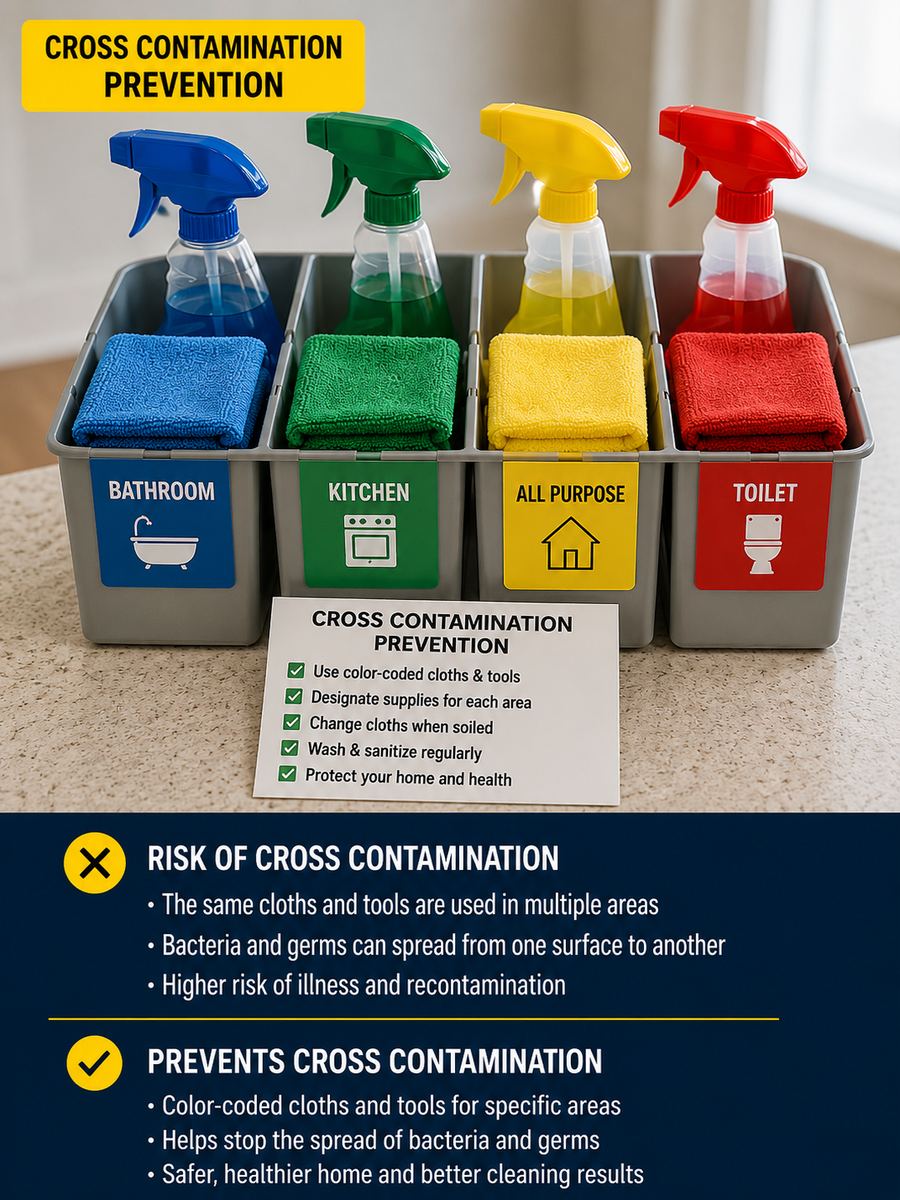
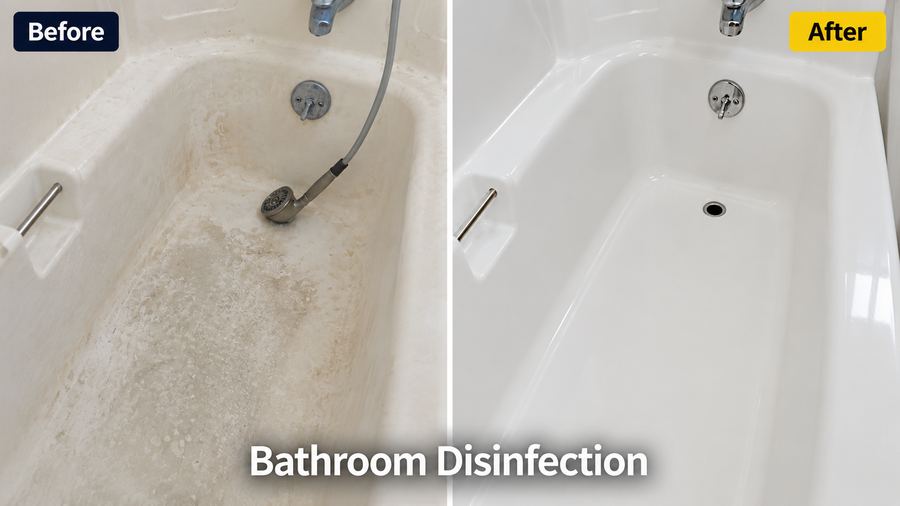
Routine restroom care may include toilets and urinals, sinks and counters, mirrors, partitions, handles, dispensers, floors, trash, odor-source cleaning, and restocking when that's part of the contracted scope. Restroom tools stay dedicated to restroom work, a clean-to-dirty workflow applies throughout, and cleaning comes before disinfecting wherever that's required by the product label. Sewage, sharps, significant bodily fluids, and plumbing repairs remain outside normal scope. This connects directly to the detail described in our bathroom cleaning, sanitizing & disinfection guide and the tool-separation standards in our cross-contamination prevention guide.
Floor Care
| Floor Type | Routine Care | Specialty Care (Separate Scope) |
|---|---|---|
| Carpet | Vacuuming | Carpet extraction, stain treatment |
| Carpet tile | Vacuuming | Extraction, individual tile replacement |
| Luxury vinyl | Mopping | Specialty finish treatments |
| Sheet vinyl | Mopping | Seam sealing, specialty finishes |
| VCT | Mopping | Stripping and waxing, burnishing |
| Tile and grout | Mopping | Grout restoration, sealing |
| Concrete | Sweeping/mopping | Sealing, specialty coatings |
| Rubber flooring | Mopping | Specialty cleaners, resealing |
| Hardwood | Dry/damp mopping | Refinishing |
| Natural stone | Mopping with pH-neutral product | Stone restoration, sealing |
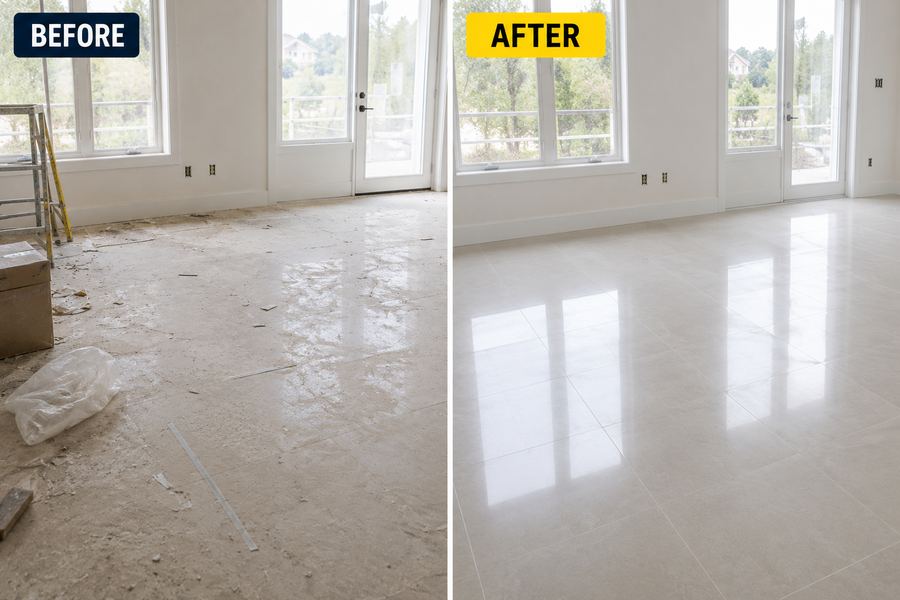
Routine vacuuming and mopping are different from carpet extraction, stripping and waxing, burnishing, stone restoration, grout restoration, or slip-resistance treatments — those are specialty services that get their own scope and pricing. The written proposal defines exactly which floor care is included in your recurring visits versus what would need a separate project quote.
Who Supplies Paper Products, Soap, and Liners?
This is worth nailing down clearly rather than assuming. The agreement should identify who supplies toilet paper, paper towels, hand soap, trash liners, sanitizer, feminine-hygiene products, dish soap, and air freshener; where that inventory is stored; who monitors stock levels; whether restocking is included in the service; and who approves replacement orders when supplies run low. We don't assume consumables are automatically included in the cleaning price — that's one of the specific things the walkthrough and proposal nail down.
Products, Fragrance, and Surface Considerations
Products are selected according to the specific surface and scope of work. Chemicals are never mixed. Labels and contact times are followed as written. Natural stone, electronics, food-contact areas, and coated surfaces all require special care and product compatibility. Fragrance preferences and sensitivities should be disclosed during onboarding so we can account for them. Client-provided products are used only when that's been agreed upon in advance. We don't guarantee an allergen-free, fragrance-free, or specific medical outcome from any product choice.
How Consistency Is Maintained
Consistency comes from a defined process, not individual effort alone: a site-specific written checklist, a named client contact, technician notes from each visit, a process for reporting issues, a process for reporting damage or supply needs, a feedback channel for the client, clear communication around schedule changes, periodic account review, and corrective follow-up when a task gets missed. We're not going to invent exact inspection schedules, specific software platforms, photo-reporting systems, or guaranteed correction timeframes here — those details, where they apply, are part of your specific account setup.
As we've said from the start of building out these commercial relationships: we represent the company. We're there to be their right hand. That mindset shows up in how consistently we follow the checklist, how we communicate when something needs attention, and how seriously we take being an extension of your business's professional image.
When Standard Commercial Cleaning Is Not the Right Service
Some situations go beyond what standard commercial cleaning is equipped to handle:
- Significant blood
- Bodily fluids
- Sharps
- Medical waste
- Sewage
- Mold remediation
- Pest waste
- Hazardous chemicals
- Unknown powders
- Hoarding conditions
- Fire and smoke damage
- Crime-scene cleanup
- Industrial contamination
- Asbestos
- Lead
- Regulated hazardous waste
In any of these situations, we may pause, decline, or refer the work to the appropriate specialist.
A Real Case Study: When Employees Were Expected to Maintain the Clinic
One commercial client that stands out is a clinic that had been relying primarily on its own employees to handle cleaning. Like many businesses, the intention was good — but without a dedicated system, important tasks were consistently missed. When we evaluated the facility, we found bathrooms that weren't being consistently addressed, dust accumulating on overlooked surfaces, and high-touch areas receiving inconsistent attention.
The problem wasn't that employees didn't care. The problem was that no one had been given dedicated ownership, time, tools, and a professional cleaning system. Staff had other jobs to do, and cleaning kept getting squeezed into whatever time was left over — which meant it happened inconsistently, not because anyone was careless.
For a clinic, cleanliness is often one of the first things patients notice — a dusty reception area or an inconsistently maintained restroom can leave an impression before a patient has even interacted with staff. Introducing a documented system with clear ownership changed that experience for both the clinic's patients and its own team, who no longer had cleaning competing with their actual job responsibilities.
Is Professional Commercial Cleaning Right for Your Business?
It may be appropriate if:
- Cleaning has been inconsistent from one week to the next.
- Your restrooms are customer- or patient-facing.
- Employees are being pulled away from their core duties to handle cleaning.
- You'd prefer after-hours service that doesn't disrupt operations.
- You want a documented checklist rather than an informal arrangement.
- Your facility has multiple zones requiring different cleaning methods.
- You want a recurring accountability system, not a one-off fix.
It may not be appropriate without separate assessment if:
- Biohazard cleanup is required.
- Medical terminal cleaning is being requested.
- Hood-duct cleaning is needed.
- Active sewage is present.
- Hazardous chemicals are present.
- Industrial contamination exists.
- The facility can't provide safe access.
- The requested scope requires a licensed specialty contractor.
Employee Tidying vs. Professional Cleaning
Employee tidying may be appropriate for:
- Immediate spills.
- Personal desks.
- Small trash.
- General straightening throughout the day.
- Day-to-day appearance between professional visits.
Professional cleaning adds:
- Defined ownership of the task.
- Dedicated time, not squeezed between other responsibilities.
- Commercial-grade equipment.
- Site-specific products chosen for your facility.
- A written checklist.
- Cross-contamination controls.
- Recurring, reliable scheduling.
- Ongoing account communication.
- A documented scope everyone can reference.
Both have a place — this isn't about replacing every bit of employee tidying, it's about not expecting staff to substitute for a dedicated system.
North County San Diego Relevance
Cali Clean Team provides commercial cleaning throughout North County San Diego — San Marcos, Carlsbad, Oceanside, Vista, and Escondido — for offices, medical and dental practices, retail stores, restaurants, and commercial kitchens. Facility type, traffic, flooring, operating hours, and customer expectations matter far more than which specific city a business is in. Whatever type of business you operate and wherever you're located in the region, every account starts with the same walkthrough and a customized checklist built around consistent operating principles.
This connects naturally to our cross-contamination prevention guide and bathroom cleaning, sanitizing & disinfection guide for restroom-specific detail, our stainless steel care guide for commercial kitchen equipment, and our post-construction cleaning guide for build-outs and renovations. Rotational deep-cleaning tasks are informed by our baseboard & corner cleaning guide and ceiling fan & light fixture guide. For general residential-adjacent services, see our deep cleaning and house cleaning pages, or find your area on our San Marcos, Carlsbad, Oceanside, Vista, or Escondido service pages.
Preparing for the Walkthrough
- [ ] Approximate facility square footage
- [ ] Business type
- [ ] Operating hours
- [ ] Employee count
- [ ] Typical customer traffic
- [ ] Number of restrooms
- [ ] Flooring types throughout the facility
- [ ] Break rooms or kitchens on-site
- [ ] Any restricted or sensitive areas
- [ ] Current cleaning pain points
- [ ] Desired service frequency
- [ ] Who's currently responsible for consumables
- [ ] Access and alarm procedures
- [ ] Fragrance or product preferences/sensitivities
- [ ] Any known hazards on-site
- [ ] Target start date
Setting Realistic Expectations
Cleaning may improve: appearance, restroom presentation, dust, trash management, floor cleanliness, break-room condition, entry areas, agreed high-touch surfaces, customer-facing spaces, and consistency across visits.
Commercial cleaning cannot guarantee: sterility, illness prevention, removal of permanent stains, repair of damaged floors or fixtures, elimination of every odor, pest control, plumbing repair, medical-grade infection control, results outside the written contract, or uninterrupted work when access isn't available.