Stainless Steel Care at a Glance
| Best For | Dull, fingerprinted, mineral-spotted, or lightly rust-affected stainless steel appliances and commercial equipment |
| Residential Service Type | Cleaning and polishing, often paired with a standard or deep cleaning visit |
| Commercial Service Type | Degreasing and cleaning of bare stainless equipment and surfaces |
| Finish-Identification Requirement | Always — the finish type is identified before any product or tool is selected |
| What May Improve | Fingerprints, grease, food residue, smudges, product haze, light mineral film, some transferred rust, residue-related dullness |
| What May Remain | Deep scratches, dents, pitting, peeling coatings, worn fingerprint-resistant finishes, heat damage, factory-finish loss, severe corrosion |
| Main Safety Rule | We begin with the least aggressive compatible method, not the strongest one |
| What's Excluded | Appliance disassembly, panel removal, touchscreen/electronics repair, dent repair, seal/hinge/handle repair, and hood duct cleaning |
| When Service May Be Declined | Peeling coatings requiring manufacturer service, deep pitting, electrical/mechanical problems, or equipment that can't be safely shut down or cooled |
| Cities Served | San Marcos, Carlsbad, Oceanside, Vista, Escondido, Encinitas, Solana Beach, Del Mar, La Jolla, and surrounding North County San Diego communities |
Why Stainless Steel Requires Specialized Care
Stainless steel isn't one uniform material from a cleaning standpoint. Different appliances use different finishes — some have a visible directional grain, some are coated with a fingerprint-resistant layer, some are decorated with a black or colored finish, and some (mostly commercial equipment) are bare, utilitarian stainless with no coating at all. Each of these responds differently to pressure, chemicals, and abrasion. Add in environmental deposits like hard water and coastal salt exposure, plus the sensitive electronic and mechanical components built into most modern appliances, and it becomes clear why "just wipe it down" isn't really a complete answer. Product compatibility and finish identification come before anything else.
Stainless Finish Types
| Finish Type | Common Appearance | Main Cleaning Concern | Main Precaution |
|---|---|---|---|
| Brushed stainless | Visible directional grain | Fingerprints, grease, mineral film | Follow the visible grain; avoid contaminated abrasives |
| Polished stainless | Reflective, less obvious grain | Fine scratching and haze show easily | Use very soft methods only |
| Fingerprint-resistant stainless | Factory coating applied over the metal | Coating may react to polish or abrasives | Follow the appliance manual; avoid aggressive polishing |
| Black stainless | Dark decorative coating | Scratches, peeling, and worn glossy patches | Cleaning cannot recreate a damaged coating |
| Stainless-look film or wrap | Decorative surface, not bare metal | Delamination and solvent damage | Avoid harsh solvents and abrasives |
| Commercial bare stainless | Often uncoated, utilitarian finish | Heavy grease, heat discoloration, food residue | Food-contact and label requirements matter |
Identifying which of these you actually have comes before selecting any product or tool — a method that's perfectly safe on bare commercial stainless can permanently damage a coated residential refrigerator.
Cleaning vs. Polishing vs. Restoration
Cleaning removes fingerprints, grease, food residue, dust, and compatible mineral film.
Polishing improves appearance and may leave a temporary protective or shine-enhancing layer, when that's permitted by the manufacturer for that specific finish.
Cosmetic restoration attempts to improve removable staining, light transferred rust, or residue-related dullness — without claiming to recreate the factory finish.
Repair or refinishing addresses dents, deep scratches, coating loss, severe corrosion, or physical damage, and requires a different specialist entirely.
Starting With the Least Aggressive Method
We don't rely on a single rule like "never use anything harder than the surface" as a complete technical principle — it's a helpful starting idea, but it oversimplifies what actually matters. In practice:
- We begin with the least aggressive compatible method available for that specific finish.
- Even a microfiber cloth can scratch a surface if grit gets trapped underneath it — the cloth itself isn't automatically safe just because it's soft.
- Pressure and direction both matter, not just the tool.
- The shape of abrasive particles in a given product matters as much as how "gentle" the product is marketed as being.
- Coatings are often softer than the stainless steel underneath them — a tool that's perfectly safe on bare metal can still damage the coating sitting on top of it.
- A tool that's safe for bare commercial stainless equipment may damage a coated residential refrigerator, even though both are technically "stainless steel."
What "Clean With the Grain" Actually Means
Brushed stainless often has fine directional lines that are visible under good lighting — but "clean with the grain" isn't a universal instruction for every stainless surface.
- Inspect the surface under good lighting before deciding how to proceed.
- Grain direction can run horizontally or vertically, depending on the appliance and how it was manufactured.
- Some surfaces have no obvious linear grain at all — polished, patterned, or coated finishes fall into this category.
- These other finishes require different handling than brushed stainless, not the same "always rub this direction" approach.
- When we're uncertain, we use a controlled test area first rather than assuming.
Rust, Tea Staining, Mineral Deposits, and Corrosion
Appearance alone doesn't always tell you what's actually causing a spot or stain on stainless steel — which is part of why an honest assessment matters more than guessing.
| Condition | What It May Look Like | Possible Cause | May Cleaning Improve It? | When Is Damage Permanent? |
|---|---|---|---|---|
| Transferred rust | Orange/brown spots, often near edges | Rust particles from another metal object contacting the surface | Often, yes | If it's been left long enough to etch the surface |
| Surface staining | General dulling or discoloration | Residue buildup, hard water, or food contact | Often, yes | Rarely permanent on its own |
| Tea staining | Light brown speckled discoloration | Chloride exposure (often coastal) reacting with the surface | Sometimes | Can become permanent with prolonged exposure |
| Mineral deposits | Chalky white or gray film | Hard water evaporating on the surface | Often, yes | If deposits have sat long enough to etch |
| True corrosion | Reddish-brown, rough texture | Breakdown of the protective layer, often from chlorides or damage | Rarely fully | Often permanent |
| Pitting | Small pinpoint indentations | Localized corrosion over time | No | Yes — pitting is permanent |
| Heat tint | Rainbow or blue-ish discoloration | Excess heat exposure | Sometimes, partially | Can be permanent depending on severity |
| Adhesive or product haze | Cloudy film, sometimes sticky | Leftover product residue or adhesive | Usually, yes | Rarely permanent |
We can't always determine the cause just by looking — sometimes it takes testing a small area to see how the surface responds before we know how much can realistically improve.
What Never to Use Without Verification First
- Ordinary carbon-steel wool — can scratch the surface and leave iron particles behind that later rust, making the appliance look worse over time, not better.
- Contaminated abrasives — pads or tools previously used on other materials can transfer particles that cause the same rusting problem.
- Harsh abrasive powders — can dull or scratch many finishes.
- Chloride-heavy products — can accelerate corrosion, particularly in coastal environments.
- Undiluted acids — can etch or damage many stainless finishes.
- Oven cleaner on appliance exteriors — formulated for a different surface and purpose entirely.
- Scouring pads — too abrasive for most finishes, especially coated ones.
- Solvents on coated finishes — can strip or damage the coating.
- Universal polish on fingerprint-resistant coatings — some coatings react poorly to products that work fine on bare stainless.
This isn't an exhaustive, disconnected list of banned products — it's a reflection of what the appliance manufacturer's instructions and the product's own label typically call for on sensitive or coated finishes. Stainless-steel-specific abrasives are not automatically safe for every appliance either; a coated finish may prohibit abrasive treatment altogether, and the manufacturer's instructions control that decision, not a general assumption about what's "safe for stainless."
Stainless Steel Is Only the Exterior Finish
It's worth remembering that stainless steel is just the visible surface — underneath and around it are components that require an entirely different kind of care:
- Touchscreens
- Control panels
- Buttons
- Ice and water dispensers
- Door seals
- Burner openings
- Ignition systems
- Hood vents
- Appliance seams
- Serial labels
- Decorative lettering
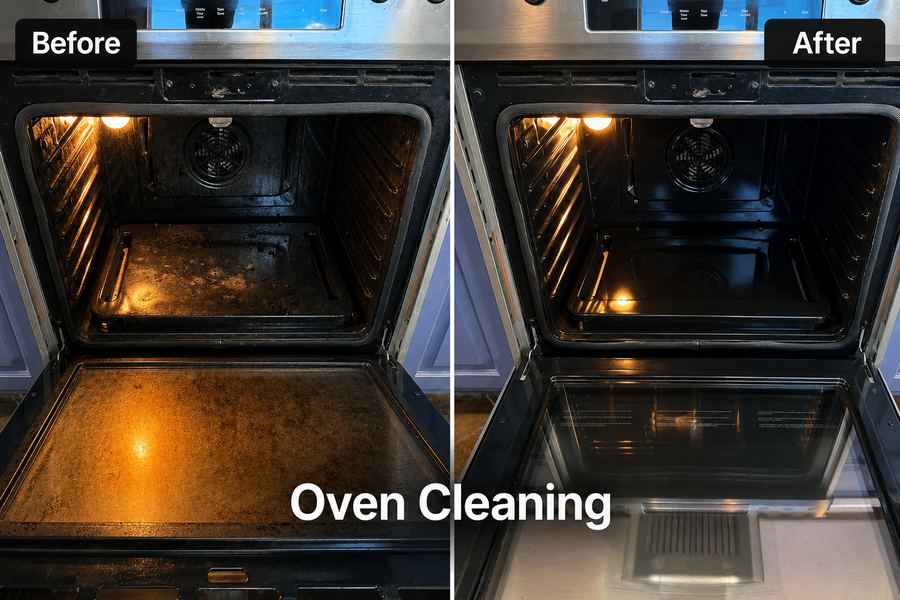
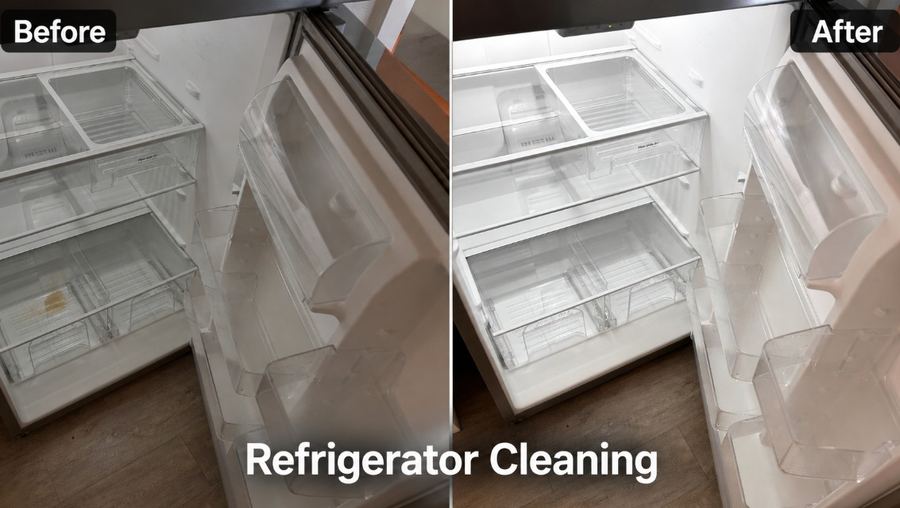
We don't disassemble appliances, remove panels, polish touchscreens, repair electronics, repair dents, repair seals/hinges/handles, or introduce liquid into electrical or mechanical openings. This connects directly to the boundaries described in our oven cleaning guide and refrigerator cleaning guide, both of which cover appliance-specific sensitive components in more detail.
Black and Fingerprint-Resistant Stainless Steel
These finishes commonly use a factory-applied coating over the underlying metal, which changes what's safe to do to them:
- Scratching or peeling can expose a different color underneath the coating.
- Aggressive rubbing can create glossy patches that stand out against the rest of the matte or textured finish.
- Polish products can cause an uneven appearance if they're not designed for that specific coating.
- Cleaning cannot recreate a coating that's already missing or worn away.
- Damaged coatings may require appliance-manufacturer service, panel replacement, or professional refinishing — none of which are things we perform.
We also don't assume every dark-colored appliance is "black stainless steel" without confirming that — some dark finishes are a different material or coating system entirely, and treating them the same way can cause damage.
Residential vs. Commercial Stainless Steel
| Topic | Residential Appliance | Commercial Stainless Equipment |
|---|---|---|
| Typical buildup | Fingerprints, food residue, light grease, mineral film | Heavy grease, carbonized residue, food soils |
| Finish | Often coated or decorative | Often bare, utilitarian stainless |
| Food-contact concern | Dispensers, handles, some interior/exterior surfaces | Prep tables, sinks, equipment surfaces |
| Product selection | Manufacturer guidance is critical | Label, facility, and food-contact requirements |
| Main boundary | Electronics, coatings, and seals | Hood ducts, internal machinery, and hot equipment |
For commercial work, equipment needs to be cool enough to clean safely, food and utensils are removed or protected beforehand, food-contact surfaces may require rinsing after cleaning, and surface cleaning is never treated as equivalent to exhaust-hood duct cleaning. Lockout, shutdown, and equipment servicing remain the facility's own responsibility where applicable — that's outside what a cleaning service performs. We also don't assume every piece of commercial stainless should be polished; a utilitarian prep surface often just needs to be genuinely clean and degreased, not shined.
Is Professional Stainless Steel Cleaning Right for You?
It may be useful if:
- Fingerprints and grease seem to return quickly no matter how often you wipe.
- Mineral film is visibly building up.
- A refrigerator or oven looks dull from residue rather than damage.
- Light rust-colored spotting is present.
- A commercial surface has heavy grease buildup.
- You're not sure what finish type you actually have.
- You're considering replacement mainly because of appearance, not function.
It may not be the correct service if:
- The coating is visibly peeling.
- Deep scratches or dents are present.
- Corrosion has progressed to deep pitting.
- There's an electrical or mechanical problem with the appliance.
- The surface is a decorative film or wrap requiring manufacturer service.
- Internal hood or duct cleaning is what's actually needed.
- Equipment can't be safely shut down or cooled for cleaning.
- Hazardous chemical residue is present.
DIY vs. Professional Care
DIY may be appropriate for:
- Routine fingerprint removal.
- Manufacturer-approved products for your specific appliance.
- Light grease on a known brushed finish.
- Regular, ongoing maintenance.
Professional assessment may be useful for:
- Unknown or uncertain coatings.
- Rust-colored spots you're not sure how to address.
- Heavy grease buildup.
- Commercial equipment.
- Multiple appliances at once.
- Prior damage from an abrasive product or tool.
- Homeowners genuinely weighing cleaning against replacement.
There's no shame in handling routine fingerprint maintenance yourself — this guide is about recognizing when a more careful, finish-aware approach adds real value.
How Cali Clean Team Cleans Stainless Steel
We inspect before we clean, and our guiding principle throughout is simple: restore the finish, never sacrifice the finish.
- Confirm the scope of the job.
- Identify the appliance and finish type before touching anything.
- Inspect existing scratches, coating damage, and corrosion.
- Review manufacturer care guidance when available.
- Protect controls, seals, flooring, and adjacent materials.
- Remove loose grit first, before any wiping begins.
- Test an inconspicuous area when needed.
- Clean using the least aggressive compatible method for that finish.
- Follow the visible grain, where applicable.
- Address grease, mineral film, or rust-colored spots separately, since each responds differently.
- Rinse where required by the product or surface.
- Dry fully.
- Polish only when permitted for that specific finish.
- Final inspection under good lighting.
- Explain permanent conditions honestly, rather than promising a result we can't deliver.
We don't claim one product or abrasive works everywhere — the method is selected based on what we find during inspection, not a fixed recipe.
A Real Case Study: Restoring a Stainless Steel Refrigerator in San Marcos
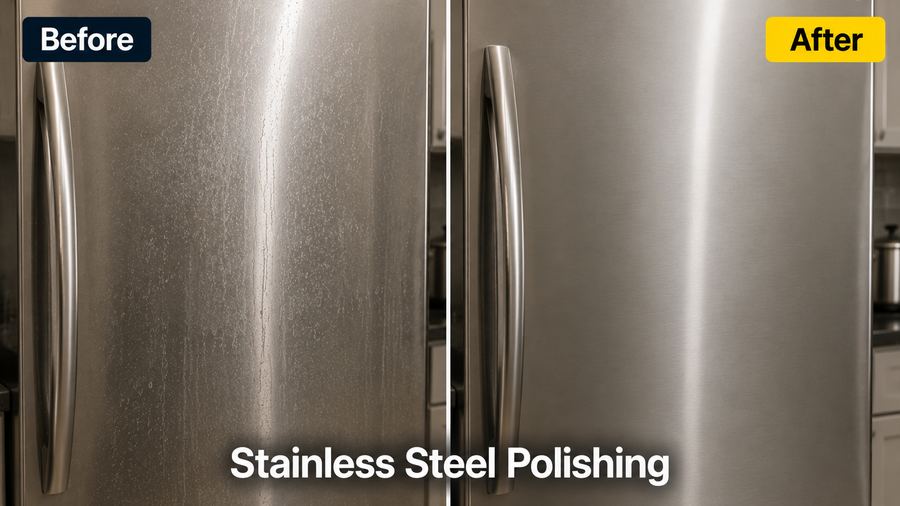
One project that stands out involved a home in San Marcos where the homeowner believed their stainless steel refrigerator had reached the end of its life. Years of fingerprints, grease, hard water spotting, and general neglect had left the finish looking dull and heavily worn.
Rather than recommending replacement, we assessed the finish first. Working with the surface's actual condition, we removed accumulated residue, worked with the visible grain where it applied, and addressed the mineral spotting and grease buildup as separate issues. By the end of the job, the appliance's appearance had improved substantially — dramatically better than when we started, though not a recreation of a factory-new finish.
This case doesn't guarantee the same result for every appliance — the outcome depends entirely on the specific finish, its condition, and how much of what's visible is genuinely removable residue versus permanent wear.
[Publisher note: verify the exact facts of this case — appliance brand, extent of rust removed, and whether Dawn Powerwash and Sprayway were the specific products used — before publishing. These products, if accurate to this case, should be presented only as what was used in this specific instance, not as a universal recommendation for every stainless appliance. Confirm permission before using any direct homeowner quote.]
Coastal and Inland Field Observations
In our field experience, some coastal North County properties may experience more chloride and salt deposition on stainless steel, especially with direct exposure to ocean air — this can show up as tea staining, transferred rust, or accelerated corrosion at edges and seams over time. That said, condition still depends on the stainless grade, whether it's coated, distance from the ocean, indoor versus outdoor placement, local water chemistry, the cleaning products used, maintenance frequency, existing scratches, and even contact with other metals.
This isn't a claim that every appliance in Carlsbad, Oceanside, Encinitas, Solana Beach, Del Mar, or La Jolla is affected the same way, or that homes further inland in Vista, San Marcos, or Escondido are automatically unaffected by hard water and general wear. It's a field observation, not a blanket rule — we've seen well-maintained coastal appliances in far better shape than neglected inland ones.
Hard-Water Spotting
Mineral deposits from hard water sit on top of the finish initially, and many can be removed safely with the right approach. Left long enough, though, deposits can contribute to staining, etching, or even corrosion in some cases. Acidic treatments — even ones marketed for hard water — can damage coated appliances or adjacent materials if they aren't compatible with that specific finish, so any hard-water removal method needs to be finish-compatible, not just effective. If etching or pitting has already occurred, that remains after cleaning regardless of technique.
Setting Realistic Expectations
Cleaning may improve: fingerprints, grease, food residue, smudges, product haze, light mineral film, some transferred rust, and residue-related dullness.
Cleaning may not correct: deep scratches, dents, pitting, peeling coatings, worn fingerprint-resistant finishes, heat damage, factory-finish loss, severe corrosion, gouges, delamination, or permanent etching.
We don't promise "like new" — we promise an honest, finish-appropriate cleaning that improves what's genuinely removable.
Preparing for Service
- [ ] Share the appliance brand and model when possible
- [ ] Send photos in natural light so we can get an initial read on the finish
- [ ] Disclose any prior products or abrasives that have been used on the surface
- [ ] Remove magnets, papers, and items from appliance doors
- [ ] Clear nearby counters
- [ ] Remove food or utensils from commercial work zones
- [ ] Allow hot equipment to cool before we arrive
- [ ] Disclose any known coating damage, dents, or peeling
- [ ] Confirm access to all sides of the appliance/equipment included in scope
- [ ] Identify any food-contact surfaces involved
- [ ] Mention any known chemical contamination
Maintenance After Cleaning
- Remove fingerprints regularly rather than letting them accumulate.
- Wipe spills promptly.
- Use manufacturer-approved products for your specific appliance.
- Follow the visible grain where that applies to your finish.
- Use clean cloths free of trapped grit.
- Avoid ordinary steel wool entirely.
- Dry mineral deposits rather than letting them sit and harden.
- Maintain coastal-exposed surfaces more frequently than inland ones.
- Don't polish coated finishes unless the manufacturer specifically approves it.
- Address corrosion early, before it has a chance to progress.
- Keep incompatible metals and wet debris away from seams where practical.
Regular maintenance meaningfully reduces problems, but we're not going to promise that any routine — weekly or otherwise — prevents all corrosion. Some of it depends on factors outside anyone's control, like water chemistry and proximity to the coast.
Local Relevance
Cali Clean Team cares for stainless steel appliances and equipment throughout North County San Diego, including San Marcos, Carlsbad, Oceanside, Vista, Escondido, and coastal communities like Encinitas, Solana Beach, Del Mar, and La Jolla. Coastal properties may see more chloride-related staining and corrosion risk due to salt air exposure, while inland properties deal primarily with hard water — but in both cases, the specific finish, maintenance history, and product use matter more than the zip code alone.
Stainless steel care connects naturally to our oven cleaning guide and refrigerator cleaning guide for a complete kitchen appliance refresh, and the same finish-first, manufacturer-aware philosophy applies to newly installed stainless equipment addressed in our post-construction cleaning guide. Our cross-contamination prevention guide informs how we handle food-contact commercial surfaces. It's commonly included in standard house cleaning and deep cleaning visits, and commercial kitchens can find related guidance in our commercial cleaning services. If you're preparing a rental for new tenants, this pairs well with move-out cleaning. Find your area on our San Marcos, Carlsbad, Oceanside, Vista, or Escondido service pages.