Ceiling Fan & Fixture Cleaning at a Glance
| Best For | Dusty, cobweb-covered ceiling fans and light fixtures within safe, stable reach |
| Service Type | Available upon request — not automatically included in standard cleaning |
| What May Be Included | Fan blade tops/bottoms, accessible housing, pull chains, exterior fixture surfaces, compatible removable globes, visible cobwebs |
| What Requires Permission | Opening any enclosed globe or shade, even when it appears removable |
| What Requires Separate Assessment | Chandeliers, multi-globe fixtures, crystal detailing, two-story ceilings, fixtures above stairs, heavy grease/smoke residue |
| What's Excluded | Electrical repair, hardwired fixture removal, motor servicing, internal wiring, fixture installation, scaffolding, attic access |
| Main Safety Rule | We don't stand on furniture, overreach, or work beneath an unstable fixture |
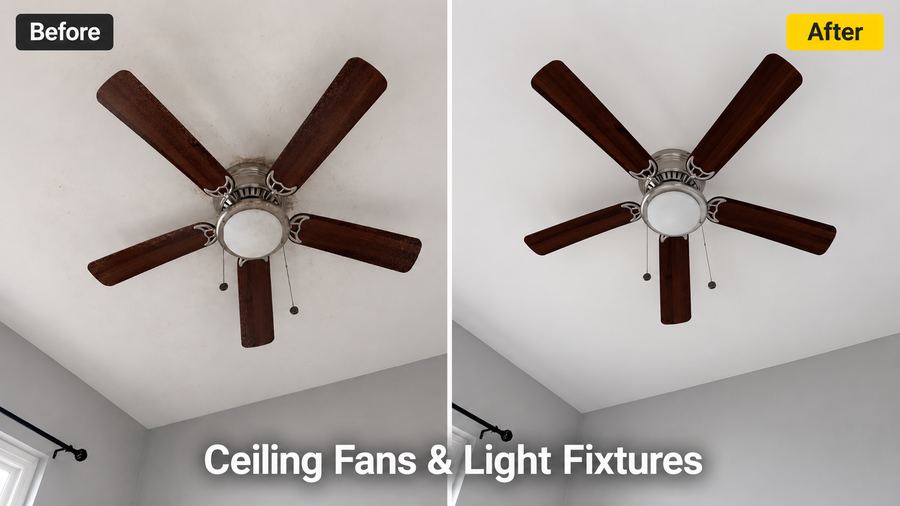
| What May Improve | Loose dust, cobwebs, pet hair, light grease film, fingerprints, accessible insect debris, dust on blade tops |
| What May Remain | Yellowed plastic, rust, corrosion, heat damage, smoke staining, peeling coatings, broken glass, wobbling fans |
| When Service May Be Declined | Wobbling or unstable fans, visible electrical damage, unsafe access, or fixtures requiring disassembly |
| Cities Served | San Marcos, Carlsbad, Oceanside, Vista, Escondido, and surrounding North County San Diego communities |
Why Overhead Surfaces Are Commonly Missed
Ceiling fans and light fixtures are easy to overlook simply because they're above eye level — out of sight often becomes out of mind. A few things compound this: dust accumulates gradually enough that it doesn't register as a problem until someone points it out; pet dander and cobwebs collect in the same overlooked corners; air movement from the fan itself and general household airflow carries dust upward; the heat from light fixtures can attract insects over time; and furniture positioned below sometimes blocks easy access anyway. Buildup becomes noticeable gradually, which is exactly why it tends to go unaddressed for a long time.
Ceiling Fans vs. Light Fixtures
| Surface Type | Typical Cleaning | Main Risks | Main Limits |
|---|---|---|---|
| Ceiling fan | Loose dust capture, compatible blade wiping, exterior housing care | Height, blade damage, balance, motor openings | No motor repair or cleaning of unstable fans |
| Flush-mount fixture | Exterior wiping, compatible globe cleaning when safely removable | Hot bulbs, fragile glass, electrical components | No hardwired removal |
| Pendant fixture | Exterior shade and stem cleaning | Height, swinging fixture, fragile shade | Limited by reach and stability |
| Chandelier | Accessible exterior dusting or selected detailing | Fragile crystals, height, complex parts | Often requires a separate assessment |
| Recessed lighting | Exterior trim cleaning only | Heat, electrical opening, fragile trim | No internal housing or wiring work |
| Integrated LED fixture | Exterior surface only | Non-removable components, electronics | No disassembly or LED repair |
Each fixture is assessed individually — a ceiling fan and a chandelier in the same room don't get the same treatment just because they're both "overhead."
Safe Access Comes First
Before anything gets cleaned, we look at whether it can genuinely be reached safely. That depends on ceiling height, whether the flooring below is stable and level, nearby stairwells, furniture positioned underneath, where a ladder can actually be placed, how far a technician needs to reach, what equipment is available, the fixture's weight and fragility, and whether safe three-point contact can be maintained throughout the work.
Standard service does not include standing on beds, chairs, countertops, or other furniture; leaning or overreaching to reach a fixture; two-story foyers without approved equipment; tall stairwell fixtures; scaffolding; roof or attic access; moving extremely heavy furniture to gain access; or working beneath a fixture that appears unstable. We're not going to publish a specific maximum ladder height here, since that depends on the equipment and conditions for a given job — but the underlying principle doesn't change: if it can't be reached safely, it doesn't get cleaned that visit.
Cleaning the Exterior Is Not Electrical Work
We take a clear, conservative position on electrical safety:
- Fixtures are switched off before cleaning begins.
- Bulbs and fixtures are allowed to cool first.
- Product is kept away from sockets, wiring, motors, and any openings.
- Liquid is never sprayed into electrical components.
- Hardwired fixtures are not removed.
- Electrical housings are not opened.
- Integrated LED assemblies are not disassembled.
- Flickering, sparking, loose wiring, or damaged sockets require an electrician, not a cleaning visit.
- Some fixture instructions may call for disconnecting power beyond just the wall switch — we follow that guidance rather than assuming a switch alone is sufficient.
- We do not perform electrical diagnosis or repair of any kind.
We're not providing electrical repair instructions here — this section exists so you understand where our boundary sits and why we won't cross it, even for something that seems minor.
Fan-Blade Materials
| Material | Common Concern | Cleaning Sensitivity | Main Limitation |
|---|---|---|---|
| Painted wood | Chipping, dust in grain | Moderate | Avoid excess moisture and abrasion |
| Veneer | Peeling, moisture damage | High | Can swell or delaminate if over-wetted |
| MDF | Swelling from moisture | High | Avoid standing water entirely |
| Plastic | Scratching, static dust cling | Low to moderate | Avoid harsh solvents |
| Metal | Corrosion on coated finishes | Varies by coating | Avoid abrasives on painted metal |
| Faux wood | Similar to painted wood | Moderate | Avoid excess moisture |
| Rattan or woven blades | Dust trapped in weave | High | Requires gentle, low-moisture methods |
| Fabric-covered blades | Dust and staining | High | Avoid soaking; spot-clean only |
| Coated composite | Coating wear | Varies | Follow manufacturer guidance where available |
Excess moisture can swell MDF or veneer blades, and loose, cracked, or otherwise unstable blades may not be safe to clean at all — a wobbly or damaged blade is a stability concern before it's a cleaning one.
Light-Fixture Materials
| Material | Cleaning Approach |
|---|---|
| Clear glass | Can generally be wiped with a compatible glass cleaner |
| Frosted glass | Similar to clear glass, with attention to texture that can trap dust |
| Crystal | Delicate; often requires careful, specialized handling |
| Acrylic | Can scratch easily; avoid abrasive cloths |
| Plastic | Generally durable but can yellow or scratch |
| Brass | Can tarnish; avoid acidic or abrasive cleaners on unlacquered finishes |
| Chrome | Can show water spots and scratches from abrasives |
| Matte black | Shows fingerprints and scratches easily; avoid anything abrasive |
| Painted metal | Can chip or wear with harsh solvents |
| Fabric shade | Usually dry methods only; avoid moisture |
| Paper shade | Very sensitive to moisture; dry dusting only |
| Wood | Sensitive to standing moisture |
| Natural stone | Acid-sensitive; avoid acidic cleaners |
| Decorative coatings | Varies significantly; test first when uncertain |
Some of these materials can be wiped safely, some require dry methods only, and some shouldn't be cleaned beyond light dusting without specialist guidance — fabric and paper shades in particular are places where more aggressive cleaning tends to cause more harm than the dust itself.
Dusting, Vacuuming, and Hand Wiping
| Method | Best Use | Main Advantage | Main Limitation |
|---|---|---|---|
| Electrostatic or microfiber duster | Light, loose dust | Low moisture | May not remove adhered grime |
| Vacuum attachment | Durable, accessible surfaces | Captures loose debris | Not suitable for fragile pieces |
| Dry microfiber cloth | Delicate dusting | Controlled contact | Limited on greasy residue |
| Damp microfiber cloth | Compatible washable finishes | Removes adhered soil | Carries some moisture risk |
| Detailed hand cleaning | Compatible globes and fixtures | More thorough | Requires safe access and more time |
We don't treat feather dusters as simply "moving dust around" — loose-dust tools genuinely help with light maintenance, and electrostatic or microfiber tools can capture a meaningful amount of dust. Heavy buildup usually calls for a more controlled combination of capture followed by finish-compatible wiping, and vacuum attachments can work well on durable surfaces but aren't appropriate for fragile pieces. Aggressive brushing, regardless of tool, can resuspend dust rather than removing it — the right method depends on the material, its condition, and how it's accessed, not a single default approach.
Can Dusty Fans Affect the Room?
Fan operation can disturb dust that's accumulated on the blades, and cleaning removes some of that settled dust from accessible surfaces. It's worth being precise about what we can and can't claim here: cleaning itself can also temporarily disturb particles during the process, and lower surfaces in the room may need a follow-up wipe-down afterward. We don't test indoor air, and fan cleaning is not allergy, asthma, or respiratory treatment — we're not going to guarantee any measurable health outcome from this service.
Globe and Shade Removal
Opening or removing a globe or shade isn't something we do automatically, even when it looks simple:
- Permission is required from the homeowner first.
- The fixture must be cool before we touch it.
- The component must be designed for routine removal — not every globe is meant to come off easily.
- Hardware must not be corroded, brittle, painted shut, or otherwise unstable.
- The technician must be able to support the piece safely throughout the process.
- A secure location must be available for the removed glass or shade while it's being cleaned.
- No electrical disassembly can be required to access it.
- Manufacturer guidance, where available, must allow the method we're planning to use.
Some globes and shades remain unopened even with the homeowner's permission, if the risk of damage or an unsafe attempt is too high. We'd rather leave a globe dusty than risk breaking it or getting hurt trying to remove it.
Chandeliers and Decorative Fixtures
Chandeliers and other decorative fixtures get their own category because they're genuinely different from a standard fan or flush-mount light. Accessible exterior dusting may be possible on many of them, but crystal-by-crystal cleaning is a more specialized undertaking than routine dusting. Small hooks, pins, and decorative parts can loosen with handling, high ceilings often require specialty equipment beyond what a standard cleaning visit uses, and fragile or high-value fixtures may simply be declined for that portion of the work. Disassembly requires a separate assessment entirely — and to be direct about it, a homeowner's permission doesn't override a genuine safety concern on our end.
We don't want to imply that our routine add-on service includes complete chandelier restoration — that's a different, more specialized service than what's described in this guide.
Fan Condition and Repair Boundaries
Cleaning cannot fix wobbling, clicking, loose blade arms, motor noise, broken pull chains, cracked blades, peeling veneer, loose light kits, damaged mounting hardware, or electrical faults. If a fan appears unstable or damaged during our inspection, we may decline cleaning that fixture until it's been repaired — working on an unstable fan is a safety risk for both the fixture and whoever is standing beneath it.
Furniture and Room Protection
Cleaning overhead surfaces means dust falls — that's simply physics, not a failure of technique. We take precautions around beds, upholstered furniture, electronics, dining tables, artwork, hardwood floors, carpet, fragile décor, open food, and children's items. Loose dust is captured before any wet wiping happens, and clean covers may be used over furniture when that's practical. The area below is cleaned afterward when that's included in the visit. Even with these precautions, some dust fall may still occur — and any covers we use are chosen so they don't damage whatever delicate surface is underneath them.
What's Included in This Requested Service
May be included when requested and safely accessible:
- Tops and bottoms of fan blades
- Accessible exterior fan housing
- Accessible pull chains
- Exterior fixture surfaces
- Compatible removable globes
- Visible cobwebs
- Surrounding ceiling dust within safe reach
May require separate assessment:
- Chandeliers
- Multiple-globe fixtures
- Crystal detailing
- Two-story ceilings
- Fixtures above stairs
- Outdoor fixtures
- Heavy grease or smoke residue
- Fixtures requiring disassembly
Outside normal scope entirely:
- Electrical repair
- Hardwired fixture removal
- Motor cleaning or repair
- Internal wiring
- Fixture installation
- Scaffolding
- Attic access
- Pest remediation
- Hazardous contamination
Is Professional Fan or Fixture Cleaning Right for You?
It may be useful if:
- Dust is visibly built up on fan blades.
- Cobwebs surround your fixtures.
- Accessible globes contain dust or insect debris.
- You're scheduling a deep clean.
- Overhead surfaces have been missed repeatedly by routine cleaning.
- Furniture below can be safely protected.
- The fixture itself is stable and genuinely accessible.
It may not be the correct service if:
- The fan wobbles or otherwise appears loose.
- There's visible electrical damage.
- The fixture is above a two-story stairwell.
- The glass is cracked.
- Hardware is corroded or unstable.
- The fixture requires hardwired disassembly.
- Scaffolding would be needed to reach it.
- Pest or hazardous contamination is present.
DIY vs. Professional Cleaning
DIY may be appropriate for:
- Low, stable fixtures you can safely reach yourself.
- Light, loose dust.
- Manufacturer-approved cleaning methods for your specific fixture.
- Homeowners with safe, appropriate equipment.
- Simple, clearly removable globes.
Professional assessment may be useful for:
- Multiple fans throughout a home.
- Fragile or decorative fixtures.
- Heavy buildup that's accumulated over time.
- Situations needing careful furniture protection.
- Fixtures made of uncertain or unfamiliar materials.
- Add-on cleaning bundled into a deep clean visit.
- Fixtures sitting right at the edge of what's safely reachable.
There's no shame in handling a low, stable fan yourself — this guide is about recognizing when height, fragility, or uncertainty make a more careful approach worthwhile.
How Cali Clean Team Cleans Fans and Fixtures
We inspect before we clean, working top to bottom — and we genuinely believe people need to look up a little more often, which is the whole reason this service exists as a specific request.
- Confirm the requested scope with the homeowner.
- Identify the fan or fixture type.
- Inspect stability, materials, and any existing damage.
- Confirm safe access before doing anything else.
- Switch off the fixture and allow it to cool.
- Protect furniture and flooring below.
- Capture loose dust first, before any wiping.
- Clean accessible surfaces with the least aggressive compatible method for that material.
- Support blades rather than bending them during cleaning.
- Keep moisture away from motors, sockets, and seams.
- Open globes only when permission and safe conditions both allow it.
- Clean compatible removable pieces safely, in a secure location.
- Reinstall components only when they're clearly designed for routine removal.
- Clean dust that's fallen below, when that's included in scope.
- Final inspection.
- Explain inaccessible or damaged areas honestly, rather than pretending they were addressed.
We don't hand-wipe or open every fixture in every home — what's actually done depends on the specific fixture, its material, and its condition.
Setting Realistic Expectations
Cleaning may improve: loose dust, cobwebs, pet hair, light grease film, fingerprints, accessible insect debris, dust on blade tops, and residue-related dullness.
Cleaning may not correct: yellowed plastic, rust, corrosion, heat damage, smoke staining, peeling coatings, broken glass, scratched acrylic, wobbling fans, electrical faults, permanent discoloration, or inaccessible internal debris.
We don't promise "like new" — we promise a careful, safety-first cleaning of what's genuinely accessible and safe to reach.
North County San Diego Relevance
Cali Clean Team offers ceiling fan and light fixture cleaning upon request throughout North County San Diego, including San Marcos, Carlsbad, Oceanside, Vista, and Escondido. Buildup tends to depend far more on how often the fan runs, general household dust, pets, ceiling height, and cleaning frequency than on which city a home is in — we haven't found a meaningful regional pattern specific to this service.
Preparing for Service
- [ ] Identify which specific fans and fixtures you'd like cleaned
- [ ] Send photos showing the fixture's height and the furniture below, if possible
- [ ] Report any wobbling, loose parts, or electrical issues you've noticed
- [ ] Clear fragile items from below the fixture
- [ ] Secure pets and children during the visit
- [ ] Confirm whether nearby furniture can be moved
- [ ] Mention if the fixture has crystal, fabric, paper, or another specialty shade
- [ ] Allow hot bulbs to cool before we arrive
- [ ] Please don't apply chemicals to the fixture before your visit
- [ ] Confirm whether globe removal is something you'd like included
Maintenance After Cleaning
- Dust light buildup regularly, rather than waiting for it to become visible from across the room.
- Keep cloths free of trapped grit.
- Use manufacturer-approved methods for your specific fixture.
- Turn fans off before doing any maintenance yourself.
- Allow bulbs and fixtures to cool before touching them.
- Avoid spraying liquids upward toward any fixture.
- Address wobbling or electrical issues promptly with a qualified technician.
- Avoid aggressive wiping on coated or painted blades.
- Clean lower surfaces after any overhead maintenance, since some dust fall is normal.
- Request professional help whenever access genuinely feels unsafe.